
Written by James Walker · Last updated: September 15, 2026
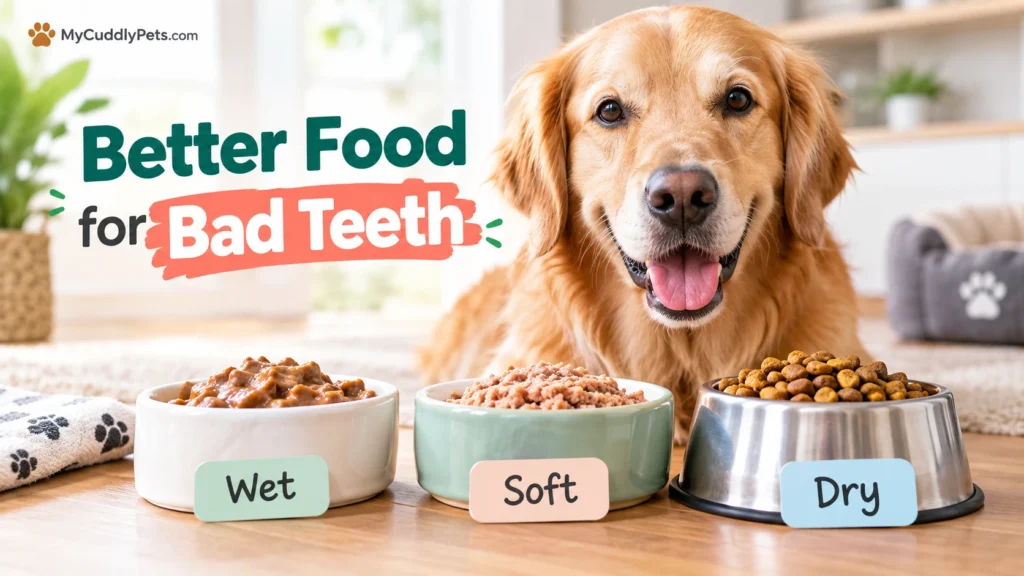
Quick Answer: If your dog has bad, loose, or missing teeth, the best choice is usually a soft, moist food — high-quality wet food, well-softened kibble, or a soft fresh/homemade meal approved by your vet. Texture matters more than the specific brand. Pair it with regular veterinary dental care, not as a replacement for it.
Key Takeaways
- Texture, not a “dental” label, is usually the deciding factor for a dog with painful or missing teeth.
- Wet food, broth-softened kibble, and soft fresh diets are the most common comfortable options.
- Dry kibble does not meaningfully clean teeth on its own — regular brushing and veterinary cleanings do the real work.
- Dogs can eat and stay well-nourished with few or no teeth if the food’s texture matches their ability to chew.
- Sudden appetite loss, dropped food, pawing at the mouth, or weight loss are signs to involve your vet, not just switch foods.
If you’ve noticed your dog hesitating at the food bowl, dropping kibble, or favoring one side of the mouth while chewing, you’re probably here because something changed — a vet mentioned dental disease, your dog lost a tooth, or you’re caring for an older dog whose mouth just isn’t what it used to be. I’m James Walker, and this guide pulls together what actually matters when you’re choosing food for a dog whose teeth are giving them trouble: what to look for, what to avoid, how much to feed, and when the issue is bigger than food and needs a vet’s attention.
Table of Contents
- What Is “Dog Food for Bad Teeth,” Exactly?
- Why Do Dogs Develop Bad Teeth?
- How Nutrition and Texture Affect a Dog’s Mouth
- Which Ingredients and Food Types Matter Most?
- How to Choose the Right Food
- How Much and How Often Should You Feed?
- How to Transition to a New Diet
- Common Mistakes Owners Make
- Common Problems and What to Do
- Wet vs. Dry vs. Softened
- Special Considerations by Dog Type
- When to Talk to a Veterinarian
- Frequently Asked Questions
- Related Reading
- Final Takeaway
This article is for general informational purposes and reflects publicly available nutrition guidance. It isn’t a substitute for personalized veterinary advice — always check with your vet about your dog’s specific needs.
What Is “Dog Food for Bad Teeth,” Exactly?
“Dog food for bad teeth” isn’t one official category — it’s shorthand for any food that a dog with dental pain, missing teeth, or gum disease can eat comfortably while still getting complete, balanced nutrition. That can mean canned (wet) food, kibble softened with water or low-sodium broth, fresh or gently cooked food, or in some cases a raw or freeze-dried diet formulated to be soft once prepared.
Some brands market “dental” kibble, which is a real category too — but it’s built for a different job. Dental-formula kibble is designed with a texture and fiber structure meant to scrape plaque off healthy teeth as a dog chews. It’s not designed for a dog whose teeth or gums already hurt. Understanding that difference is the first step to picking the right food instead of the one with the most convincing label.
Why Do Dogs Develop Bad Teeth?
Most “bad teeth” in dogs trace back to periodontal disease — inflammation and infection of the tissue and bone around the teeth. According to the American Veterinary Medical Association, periodontal disease is the most common dental condition in dogs, and most pets show some early signs of it by around age three if plaque and tartar aren’t regularly removed.
Here’s the basic mechanism: food particles and bacteria form plaque on the teeth. If plaque isn’t removed through brushing, chewing, or professional cleaning, it hardens into tartar within a matter of days. Tartar irritates the gumline, causing gingivitis (red, swollen gums), which can progress to deeper infection, bone loss around the tooth roots, and eventually tooth mobility or loss.
Other contributors include genetics (small and toy breeds are disproportionately affected because their teeth are often crowded into a small jaw), age, chewing on things that are too hard, prior trauma or fractured teeth, and inconsistent home dental care. Diet plays a supporting role in this picture — it’s rarely the sole cause, but what a dog eats and how much sticks to the teeth can speed up or slow down plaque buildup.
How Nutrition and Texture Affect a Dog’s Mouth
Once a dog already has dental pain or missing teeth, the nutrition question shifts from “what prevents plaque” to “what can this dog physically and comfortably eat while still meeting its nutrient needs.” A few factors matter most:
- Moisture content: Wet and fresh foods are typically 70–85% water, which softens texture and requires little to no chewing. This also supports hydration, which matters if a sore mouth is making a dog drink less.
- Calorie density: Wet food is generally less calorie-dense per cup than dry kibble, so portion sizes look larger for the same calorie intake — this is normal and not a sign of overfeeding.
- Protein and fat: A dog recovering from an extraction or eating less due to pain still needs adequate high-quality protein and fat to maintain muscle and body condition; don’t let softness come at the cost of nutrient density.
- Refined carbohydrates: Diets heavy in starchy fillers can leave sticky residue that clings to teeth and gumline, which may contribute to plaque formation over time, though brushing and professional care remain the primary defense.
- Complete and balanced formulation: Any food you switch to — wet, softened, or homemade — should still meet a complete and balanced nutritional adequacy statement from AAFCO for your dog’s life stage, unless a vet has specifically prescribed a therapeutic diet.
Which Ingredients and Food Types Matter Most?
High-quality animal protein (chicken, turkey, fish) supports tissue repair, which matters if gums are inflamed or healing after a procedure. Fish-based recipes also bring omega-3 fatty acids, which have some supporting evidence for reducing gum inflammation, though they’re not a substitute for treating the underlying disease.
Wet and canned foods are the most straightforward option: no chewing required, high moisture, widely available in complete-and-balanced formulas. Softened dry food (kibble soaked in warm water or low-sodium broth for 10–15 minutes) is a budget-friendly middle ground that keeps a dog on familiar food while reducing the work their mouth has to do. Fresh, gently cooked, or freeze-dried/rehydrated foods are naturally softer than kibble and often higher in moisture, but check the label for AAFCO adequacy just like any other food. Raw diets can also be soft once thawed, but should be approached carefully — raw feeding carries its own food-safety and formulation considerations that are outside the scope of “just for dental comfort,” so talk to your vet before switching.
Simple, gentle human foods — plain scrambled eggs, mashed sweet potato, plain canned pumpkin, well-cooked and shredded chicken — can supplement a soft diet, but they aren’t nutritionally complete on their own and shouldn’t replace a full, balanced meal.
How to Choose the Right Food for a Dog With Bad Teeth
Work through these factors before you buy:
- Severity of the dental issue: A dog with mild tartar and occasional tenderness may just need softened kibble. A dog recovering from multiple extractions needs fully soft, low-effort food, at least temporarily.
- Age and body condition: Underweight or senior dogs need calorie-dense soft options; overweight dogs need portion control even when switching to a softer, sometimes lower-calorie-per-cup food.
- Current chewing ability: Watch how your dog actually eats — favoring one side, dropping food, or slow eating are all clues about what texture will work.
- Known allergies or sensitivities: Don’t introduce a brand-new protein source at the same time as a texture change if you can avoid it; it makes it harder to tell what’s causing any digestive upset.
- Label details: Check the guaranteed analysis, ingredient list, and nutritional adequacy statement. A soft food should still be “complete and balanced” for your dog’s life stage, not just easy to eat.
- Feeding format that fits your routine: Canned food, rehydrated kibble, and fresh subscription meals all have different prep time, cost, and shelf-life — pick what you can realistically keep up with.
Look for these things before worrying about what to avoid: adequate moisture, a named animal protein near the top of the ingredient list, and a clear adequacy statement. Then, secondarily, watch for excessive fillers or a texture that’s simply too hard for your dog’s current mouth.
How Much and How Often Should You Feed?
Because wet and softened foods are less calorie-dense per cup than dry kibble, portions will look larger. Use the ranges below as a starting point, then fine-tune using your vet’s guidance and the feeding chart on your specific food, since calorie content varies by brand and recipe.
| Dog’s Weight | Wet/Soft Food (approx. per day) | Meal Frequency |
|---|---|---|
| 10–20 lb | 1–1.5 cans (5.5 oz) or 1.5–2 cups softened equivalent | 2–3 small meals |
| 21–50 lb | 2–3 cans (13 oz) or 3–4 cups softened equivalent | 2 meals |
| 51–90 lb | 3–4.5 cans (13 oz) or 5–6.5 cups softened equivalent | 2 meals |
| 90+ lb | 4.5+ cans (13 oz) or 6.5+ cups softened equivalent | 2 meals, sometimes 3 for large-breed comfort |
These are general starting ranges, not prescriptions — individual calorie needs vary with activity level, metabolism, age, and current body condition. A dog eating less due to mouth pain may need smaller, more frequent meals rather than two large ones. Keep treats to roughly 10% or less of daily calories, and choose soft treats (or skip treats temporarily) if your dog is recovering from dental work.
How to Transition to a Different Dog Food
Sudden diet changes can cause loose stool or digestive upset, even when the new food is objectively “better” for the mouth. A gradual transition over 5–7 days is the standard approach:
- Days 1–2: About 25% new food, 75% old food.
- Days 3–4: 50/50 mix.
- Days 5–6: About 75% new food, 25% old food.
- Day 7 onward: 100% new food.
If your dog just had teeth extracted, your vet may instead recommend switching immediately to a fully soft diet post-surgery, then transitioning back toward their regular food (or a new long-term soft option) once the mouth has healed — follow their specific timeline over this general guide. Mild, short-lived changes in stool consistency during a transition can be normal; a switch that isn’t going well usually shows up as ongoing diarrhea, vomiting, or a dog refusing to eat at all, both of which are reasons to slow down or call your vet.
Common Mistakes Dog Owners Make
- Assuming dry kibble “cleans teeth” on its own. Most dogs don’t chew kibble long enough for any real scrubbing effect — brushing and professional cleanings do the actual work.
- Switching foods too abruptly, causing avoidable digestive upset on top of an already uncomfortable mouth.
- Relying only on marketing language like “dental formula” without checking whether the texture actually suits a dog with active pain.
- Softening food but not adjusting portions, leading to under- or overfeeding once the calorie density changes.
- Treating food as the whole solution instead of pairing it with brushing, vet checkups, and treatment of the underlying dental disease.
- Assuming a higher price automatically means better dental outcomes. Texture and completeness of the diet matter more than the price tag.
Dog Food and Bad Teeth: Problems and What to Do
| Problem | Possible Reason | Practical Step | When to See a Vet |
|---|---|---|---|
| Dropping kibble while eating | Discomfort chewing hard pieces | Soften food or switch to wet/soft diet | If it continues after softening food |
| Eating slower or skipping meals | Oral pain, especially on one side | Offer smaller, more frequent soft meals | If appetite loss lasts more than a day or two |
| Weight loss with dental issues | Reduced intake or pain-related avoidance | Increase calorie density of soft meals; feed more often | Ongoing or significant weight loss |
| Bad breath despite diet change | Underlying plaque/tartar or infection, not just food | Resume or start brushing; ask about a cleaning | Persistent or worsening odor |
| Pawing at the mouth or drooling | Active pain, possible abscess or fracture | Offer only very soft food temporarily | Promptly — this can indicate an urgent issue |
Wet vs. Dry vs. Softened: A Quick Comparison
| Wet/Canned | Softened Kibble | Standard Dry Kibble | |
|---|---|---|---|
| Chewing required | Minimal to none | Reduced | Full chewing needed |
| Moisture content | High (~70–85%) | Increased vs. dry | Low (~6–10%) |
| Calorie density per cup | Lower | Same as dry, diluted | Higher |
| Cost | Generally higher | Same as current kibble | Generally lower |
| Best for | Painful/missing teeth, post-extraction | Mild discomfort, budget-conscious transition | Dogs with healthy, functional teeth |
Special Considerations
Puppies: Dental issues are less common but can occur with retained baby teeth or trauma; any puppy struggling to eat should see a vet rather than just get a diet change. Senior dogs: Often the largest group affected — softer, calorie-appropriate food that accounts for a slower metabolism and possible other health conditions is usually appropriate. Small and toy breeds: More prone to periodontal disease due to crowded teeth; consistent soft-food or softened-kibble routines can help long-term comfort. Overweight dogs: Extra weight is linked to a higher risk of periodontal disease, so portion control matters even as texture changes. Dogs with sensitive stomachs: Introduce soft or wet food gradually and stick to a single new protein at a time to avoid compounding digestive issues with a texture change.
When Should You Talk to a Veterinarian?
Diet changes can make eating more comfortable, but they don’t treat the underlying dental disease. Contact your vet if you notice: persistent bad breath, visible tartar or red/bleeding gums, a dog refusing food or eating noticeably less for more than a day, pawing at the face or mouth, drooling more than usual, blood in the water bowl or on toys, weight loss, or any swelling around the face or jaw. These can indicate infection, an abscess, or advanced periodontal disease that needs professional treatment, not just a softer bowl of food.
Frequently Asked Questions
Is wet food bad for a dog’s teeth?
No — the idea that only dry kibble is “good” for teeth is largely a myth, since most dogs don’t chew kibble enough to get a real cleaning effect. Wet food is a legitimate long-term option, especially for dogs with dental pain.
Can a dog eat with no teeth at all?
Yes. Dogs adapt well to eating with their tongue and gums when the food is soft or fully moistened, and can maintain good nutrition on wet, softened, or fresh diets.
Does dry dog food actually clean teeth?
Only to a limited degree, and mainly with kibble specifically designed with a larger, fibrous texture for that purpose. Ordinary dry food provides little meaningful cleaning benefit on its own.
Should I only feed soft food if my dog has any dental problems?
Not necessarily — it depends on severity. Mild tartar with no pain may not require a full switch, while loose teeth, extractions, or visible pain usually call for a fully soft diet, at least temporarily.
How do I soften dry dog food?
Add warm water or low-sodium broth and let it sit for 10–15 minutes until it reaches a texture your dog can manage comfortably.
Is a prescription dental diet necessary?
Not for every dog. Prescription dental diets are formulated for specific plaque-control goals and are usually recommended by a vet for a particular situation, rather than being a default requirement.
Will changing food fix my dog’s bad breath?
It may help somewhat, especially if refined carbohydrates were part of the issue, but persistent bad breath usually points to plaque, tartar, or infection that needs veterinary attention, not just a new bag of food.
Can I make homemade soft food for a dog with bad teeth?
Yes, but homemade diets need to be nutritionally complete and balanced, which is easy to get wrong without guidance — talk to your vet or a veterinary nutritionist before relying on homemade meals long-term.
How soon after a tooth extraction can my dog go back to regular food?
This varies by dog and procedure, so follow your vet’s specific timeline; many dogs need fully soft food for one to two weeks before gradually returning to their normal diet.
Final Takeaway
If your dog has bad teeth, the food that helps most is usually the one with the softest texture your dog can comfortably manage — wet food, well-softened kibble, or a soft, complete-and-balanced fresh diet — paired with adequate protein and calories so they don’t lose condition while eating less or more slowly. Diet supports comfort; it doesn’t replace brushing, professional cleanings, or veterinary treatment of the underlying dental disease. When in doubt, or if you notice pain, bleeding, or appetite changes, loop in your vet before settling on a long-term food.
