
Written by James Walker · Last updated: September 24, 2026 · Author credentials: none provided.
Quick Answer: Dog food mats sit under food and water bowls to catch crumbs, splashes, drool, and spills while helping keep bowls from sliding. For most homes, the best choice is a washable, non-slip mat that is large enough for both bowls and the surrounding mess, with a raised edge if water spills are common.
Key Takeaways
- Choose the mat for the kind of mess your dog makes: crumbs, splashes, tipped water, or all three.
- Size matters as much as material; the mat should extend beyond the full footprint of the bowls or feeder.
- Waterproof silicone or molded trays are easy to rinse and contain liquid, while absorbent mats can help with splashy drinkers but need thorough, frequent washing.
- A non-slip underside and stable bowl surface can reduce sliding during meals.
- Clean the mat often, because feeding mats and placemats can collect food residue, saliva, and moisture.
A dog food mat is a simple feeding accessory, but choosing one gets confusing quickly because products are sold as bowl mats, feeding mats, placemats, water mats, absorbent mats, and spill trays. I focus less on the name and more on what the mat actually needs to do in the feeding area. In this guide, I’ll explain materials, sizing, raised edges, grip, cleaning, common problems, and how different setups work for puppies, seniors, large dogs, and messy drinkers.
Table of Contents
- What Are Dog Food Mats?
- Why Do Feeding Areas Get Messy?
- How Food, Water, and Hygiene Affect the Mat
- Which Materials Matter Most?
- How to Choose the Right Dog Food Mat
- What Size Dog Food Mat Do You Need?
- How to Clean a Dog Food Mat
- Common Mistakes
- Dog Food Mat Problems and What to Do
- Silicone vs. Absorbent Dog Food Mats
- Special Considerations
- When Should You Talk to a Veterinarian?
- Frequently Asked Questions
- Related Reading
- Final Takeaway
This article is for general informational purposes and reflects publicly available nutrition guidance. It isn’t a substitute for personalized veterinary advice — always check with your vet about your dog’s specific needs.
What Are Dog Food Mats?
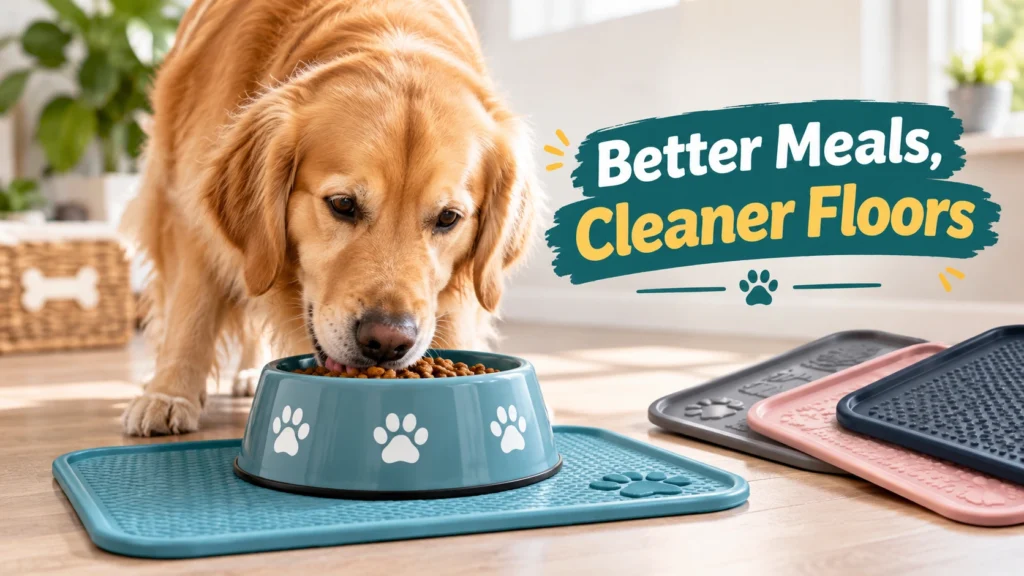
Dog food mats are protective surfaces placed under a dog’s food bowl, water bowl, automatic feeder, fountain, or feeding stand. Their main job is not to change what a dog eats. Instead, they help manage the area around the meal by catching kibble, wet-food drips, water splashes, and drool before those reach the floor.
You may also see them called dog bowl mats, pet feeding mats, pet placemats, water bowl mats, or feeding trays. A flat mat mainly creates a washable barrier. A mat with a raised lip works more like a shallow tray, helping contain liquid. An absorbent mat takes in splashed water instead of leaving it pooled on the surface.
That distinction matters because “best” depends on the actual problem. A dog that scatters dry kibble has different needs from a dog that pushes a water bowl around or drips water several inches away after drinking.
Why Do Dog Feeding Areas Get Messy?
Mess around bowls is usually mechanical rather than nutritional. Fast eating can scatter kibble. Dogs with broad muzzles, long facial hair, loose lips, or enthusiastic drinking habits may move more water outside the bowl. Puppies may paw at bowls, while larger or energetic dogs can shove lightweight dishes across smooth floors.
The feeding setup also plays a role. A bowl that is too small may encourage food to spill over the rim. A water bowl filled to the top can splash more easily. An unstable stand can shift. And a mat that barely matches the bowl footprint cannot catch material that lands beyond it.
Food type changes the cleanup problem too. Dry food produces crumbs that are easy to sweep or dump from a flexible mat. Wet or fresh food can smear and should be removed promptly. Water creates a separate issue because trapped moisture left under bowls or mats can keep the area damp.
How Food, Water, and Hygiene Affect Dog Food Mats
A feeding mat is part of the same food-contact environment as bowls and scoops, so cleanliness matters. The CDC’s pet food safety guidance specifically advises cleaning food and water bowls, food scoops, treat toys, feeding mats, and placemats frequently.
The cleaning frequency should match what lands on the mat. Dry crumbs can be removed after meals, but wet food, saliva-heavy spills, or standing water should not be allowed to remain. The FDA’s pet food storage and handling guidance recommends washing and drying pet food bowls after each use and washing water bowls daily. That same hygiene mindset is useful for the surface underneath them.
Nutrition itself does not determine which mat is best. Protein, fat, fiber, calories, or ingredients such as chicken or rice are relevant to the food, not the placemat. What matters here is feeding format: dry kibble, canned or wet food, fresh food, water, and the amount of residue each leaves behind.
Which Materials Matter Most?
Silicone
Silicone is common because it is flexible, waterproof, and easy to rinse. Many designs include a raised perimeter and textured areas intended to help bowls stay in place. If you want a tray-like surface that catches both crumbs and liquid, silicone is often the most practical starting point.
Check the manufacturer’s cleaning instructions rather than assuming every silicone mat is dishwasher-safe. Also inspect flexible mats regularly if your dog likes chewing soft objects; a feeding mat should not become a chew toy.
Rubber or Rubber-Backed Mats
Rubber can provide strong floor grip and can work well under bowls that slide. Construction varies widely, however. Some mats are solid and waterproof, while others combine a fabric top with a rubberized backing. Look for easy-clean surfaces and avoid designs with deep crevices that trap food unless you are willing to scrub them thoroughly.
Absorbent Fabric or Quick-Dry Mats
Absorbent mats are designed for water-heavy messes. Instead of holding a puddle on top, they take in splashes. That can be useful for dogs that drip after drinking, especially when the mat extends beyond the water bowl.
The tradeoff is maintenance. Absorbed moisture and food residue still have to be removed, so these mats need regular laundering or washing and complete drying. For wet food spills, a nonporous tray is often easier to sanitize.
Plastic Trays
Rigid plastic trays can provide strong containment and are easy to lift when mostly dry. They may be less convenient to store than flexible mats and can slide unless the underside has grip. Check for cracks or scratches that make cleaning harder over time.
How to Choose the Right Dog Food Mat
I use a simple order of priorities: first identify the mess, then measure the setup, then choose material and cleaning method.
- Identify the main mess. For scattered kibble, prioritize surface area. For splashed or tipped water, prioritize waterproofing and a raised edge. For drippy drinkers, consider either a large waterproof tray or an absorbent mat that can be washed often.
- Measure the bowls or feeder. Measure the complete width and depth of two bowls, a feeding stand, fountain, or automatic feeder—not just one dish.
- Add spill room. Choose a mat that extends several inches beyond the setup wherever your dog commonly drops food or water.
- Check grip. The mat should resist sliding on your floor, and the bowls should not skate across its top.
- Check the edge. A raised lip is useful for liquid containment, but a very high edge may be awkward for some seniors or dogs with mobility limitations if they step onto the mat.
- Plan the cleaning routine. A mat is only convenient if it fits your sink, dishwasher, washing machine, or preferred hand-washing method.
Marketing phrases such as “spill-proof” or “non-slip” are not guarantees. Look at the actual dimensions, edge design, underside, top texture, material, and care instructions.
What Size Dog Food Mat Do You Need?
There is no nutrition-based portion table for dog food mats, and dog weight alone cannot determine mat size. A 20-pound dog with a splashy water habit may need more floor coverage than a calm 60-pound dog. Use the dog’s bowl setup and mess radius instead.
| Feeding setup | What to measure | Practical sizing approach |
|---|---|---|
| One small bowl | Bowl diameter plus surrounding crumbs | Choose a mat clearly wider and deeper than the bowl |
| Food + water bowls | Total side-by-side footprint | Leave extra space around both bowls, especially the water side |
| Large dog or wide bowls | Outer edges of both bowls or stand | Prioritize a larger mat that catches drops beyond the rims |
| Fountain or automatic feeder | Full appliance footprint and access area | Confirm the device sits flat and does not overlap the mat edge |
| Messy drinker | Where water actually lands after drinking | Measure the real splash or drip zone and size to that area |
Before buying, place the current bowls on the floor and observe one or two normal meals. Notice where crumbs and water actually land. That real-world footprint is more useful than choosing by breed label alone.
How to Clean a Dog Food Mat
Cleaning depends on the material, so follow the manufacturer’s instructions. For washable nonporous mats, remove leftover food first, wash with soap or detergent and warm water, rinse well, and dry completely. The CDC’s guidance on cleaning pet supplies distinguishes cleaning from disinfecting and notes that routine cleaning is sufficient for many pet items, while disinfection may be appropriate in certain situations.
A practical routine is:
- Pick up spilled food after each meal.
- Wipe or rinse visible food smears and saliva.
- Empty standing water rather than letting it sit.
- Wash the mat regularly according to its care instructions.
- Dry the mat and the floor underneath before resetting the bowls.
If the mat develops an odor, sticky film, visible mold, cracks, peeling material, or damage your dog can chew off, replace it rather than trying to extend its life indefinitely.
Common Mistakes Dog Owners Make
- Buying a mat that only fits the bowls. The whole point is to catch what lands outside them.
- Ignoring the water problem. A mat that handles crumbs may still let splashed water reach the floor.
- Assuming absorbent means maintenance-free. Absorbent materials need washing and complete drying.
- Leaving trapped moisture underneath. Lift the mat periodically and dry the floor.
- Choosing by looks alone. Grip, edge height, washability, and dimensions usually matter more than color or pattern.
- Letting a chewer have unsupervised access. Soft silicone or rubber can become damaged if a dog treats it like a toy.
- Using the mat as a substitute for bowl hygiene. Clean bowls and a clean mat work together.
Dog Food Mat Problems and What to Do
| Problem | Possible reason | Practical step | When to seek veterinary advice |
|---|---|---|---|
| Water still reaches the floor | Mat too small or edge too low | Increase coverage or use a more contained tray | If drinking becomes suddenly excessive or unusual |
| Bowls keep sliding | Smooth floor, light bowls, weak grip | Use a grippier mat or more stable bowl setup | Not usually a veterinary issue |
| Mat smells | Food, saliva, or moisture buildup | Wash thoroughly and dry completely; replace if odor persists | If your dog has unusual drooling, mouth pain, or appetite changes |
| Dog chews the mat | Access, boredom, or interest in soft material | Remove the mat when unsupervised and use a safer setup | If material may have been swallowed or symptoms appear |
| Sudden increase in food mess | Changed eating behavior, bowl fit, or discomfort | Observe eating posture and check the setup | If accompanied by trouble chewing, swallowing, pain, vomiting, or appetite change |
Silicone vs. Absorbent Dog Food Mats
| Feature | Silicone or waterproof tray | Absorbent mat |
|---|---|---|
| Dry crumbs | Easy to collect and dump | Can catch crumbs but may hold them in fibers |
| Water splashes | Contains water on the surface | Absorbs smaller splashes and drips |
| Large spill | Raised edge can help contain it | Capacity depends on material and size |
| Wet food cleanup | Usually easier to rinse from a nonporous surface | May require laundering |
| Drying | Surface can often be wiped dry | Must dry through the absorbent layer |
| Best fit | Mixed food-and-water mess, easy rinsing | Frequent drips from a messy drinker |
Neither type is automatically better. If spilled water pools on silicone and your dog walks through it, an absorbent design may reduce wet paw prints. If wet food and crumbs are the bigger issue, a smooth waterproof surface may be faster to clean.
Special Considerations
Puppies
Puppies may step in bowls, push dishes, or chew anything left in reach. Prioritize stability, easy cleaning, and supervision. Remove damaged mats promptly.
Senior Dogs
For seniors, consider footing and accessibility. A mat should lie flat without curled corners, and edges should not create an unnecessary tripping obstacle. If your dog has arthritis or mobility changes, ask your veterinarian about the overall feeding setup rather than assuming a raised feeder or particular mat height is medically beneficial.
Large Dogs and Messy Drinkers
Large bowls and fountains need more surface area. Measure the complete station and choose enough room for the dog’s real splash zone. A raised edge can help if water regularly escapes the bowl.
Dogs with Skin or Food Sensitivities
A feeding mat does not treat food allergies or skin disease. If a dog develops irritation around the mouth or paws, clean the feeding area and discuss persistent signs with a veterinarian. Do not assume the mat material or the food is the cause without evaluation.
When Should You Talk to a Veterinarian?
Most feeding-mat problems are housekeeping issues, but sudden changes in eating or drinking deserve attention. Contact a veterinarian if your dog develops persistent vomiting or diarrhea, blood in stool or vomit, a major appetite or weight change, severe lethargy, signs of dehydration, repeated digestive problems, ongoing pain, difficulty chewing or swallowing, or a sudden marked increase in thirst.
If your dog chews a mat and you think pieces may have been swallowed, contact your veterinarian for advice. The concern is the swallowed material, not the mat’s effect on nutrition.
Frequently Asked Questions
What is a dog food mat used for?
A dog food mat protects the floor around food and water bowls by catching crumbs, splashes, drool, and spills. Many also add grip that can help keep bowls or feeding stands from sliding.
Are silicone dog food mats better than fabric mats?
Silicone is usually easier to rinse and is useful for containing food and water on a nonporous surface. Fabric or absorbent mats can be helpful for dogs that drip water, but they need regular washing and thorough drying. The better choice depends on the mess you are trying to control.
What size dog food mat should I buy?
Measure the full footprint of the food bowl, water bowl, stand, fountain, or feeder, then add enough surrounding space to catch the area where food and water actually land. Dog weight alone is not a reliable sizing method.
Do dog food mats need raised edges?
Not always. Flat mats can work for crumbs and small drips. A raised edge is more useful when your dog splashes water, tips bowls, or creates larger spills that would otherwise run onto the floor.
How often should I clean a dog feeding mat?
Remove food debris after meals and clean the mat frequently, especially when it has wet food, saliva, or standing water on it. Follow the material’s care instructions and dry both the mat and the floor underneath.
Can I put a dog food mat in the dishwasher?
Only if the manufacturer says the specific mat is dishwasher-safe. Material alone is not enough to assume that a product can tolerate dishwasher heat and detergent.
Can a dog food mat stop bowls from sliding?
A mat with a grippy underside and a surface that holds the bowl securely can reduce sliding, but results depend on the floor, bowl weight, bowl base, and how forcefully the dog eats or drinks.
Are absorbent dog water mats hygienic?
They can be practical when they are washed often and dried completely. Because they retain moisture by design, they should not be left damp or dirty for long periods.
Is a dog food mat necessary?
No. A dog can eat safely without one. A mat is mainly a convenience and floor-protection tool. It becomes more useful when bowls slide, food scatters, or water regularly reaches the floor.
Can a feeding mat help with a messy eater?
Yes, it can contain part of the mess, but it does not change the underlying eating behavior. If messy eating is new or comes with difficulty chewing, swallowing, vomiting, pain, or appetite changes, speak with a veterinarian.
Final Takeaway
The best dog food mat is the one that matches your dog’s actual feeding mess. Start with the problem—crumbs, water, sliding bowls, wet food, or a combination—then choose enough surface area, reliable grip, an appropriate edge, and a cleaning method you will realistically use.
For many homes, a washable waterproof mat with room around both bowls is a practical all-purpose choice. For dogs that mainly drip water, an absorbent mat may be more comfortable to live with if it is cleaned and dried properly. Whatever style you use, keep the mat and bowls clean, inspect them for damage, and treat sudden changes in eating or drinking as a health question rather than a mat problem.
