
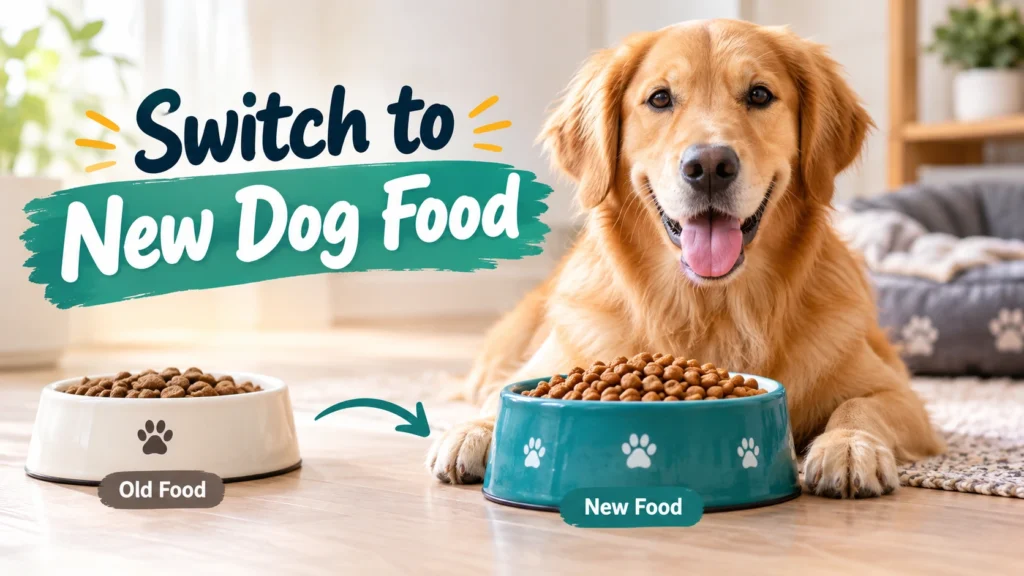
Written by James Walker · Last updated: September 18, 2026
Quick answer: Switch dog food gradually over 7–10 days, mixing in a little more new food and a little less old food each day. This gives your dog’s gut bacteria time to adjust and greatly lowers the odds of diarrhea, gas, or food refusal. Go slower for sensitive dogs, and stop or call your vet if symptoms are severe.
- Take 7–10 days minimum for most healthy adult dogs; take longer for puppies, seniors, or sensitive stomachs.
- Mix old and new food in gradually shifting ratios rather than swapping overnight.
- Mild, short-lived stool changes are common; persistent vomiting or diarrhea is not.
- Pick the new food based on your dog’s life stage, size, and any known sensitivities — not just marketing.
- If your dog stops eating or gets sick during the switch, slow down or go back a step rather than pushing forward.
Whether you’re moving your puppy onto adult food, following a vet’s recommendation, or just want to try something new, changing what’s in the bowl is one of those everyday dog-owner decisions that’s simple in theory but easy to get wrong in practice. I’m James Walker, and after years of feeding, transitioning, and occasionally troubleshooting my own dogs’ diets, I’ve learned that the difference between a smooth switch and a week of cleanup usually comes down to pace, not the food itself. This guide walks through why dogs react to food changes, how to actually do the transition, what to watch for, and when a hiccup is normal versus worth a vet call.
In this article:
- What Is “Switching Dog Food”?
- Why Do Dogs Get Upset Stomachs When Food Changes?
- How Nutrition Affects the Transition
- Which Ingredients Matter Most?
- How to Choose the Right New Food
- How Much and How Often Should You Feed?
- How to Transition, Step by Step
- Common Mistakes
- Troubleshooting Problems
- Gradual vs. Cold-Turkey
- Special Considerations
- When to Call the Vet
- FAQ
This article is for general informational purposes and reflects publicly available nutrition guidance. It isn’t a substitute for personalized veterinary advice — always check with your vet about your dog’s specific needs.
What Is “Switching Dog Food”?
Switching dog food simply means moving your dog from one diet to another — a different brand, formula, protein source, or format (say, dry kibble to wet food). People do this for a lot of reasons: a puppy growing into adulthood, a senior dog needing joint or kidney support, a vet-recommended limited-ingredient diet, a discontinued product, or simply wanting to try something new. The “switch” itself isn’t the hard part — dogs can nutritionally handle a wide range of complete and balanced foods. What matters is how you make the change, because a dog’s digestive system adjusts to whatever it’s been eating consistently, and a sudden change disrupts that balance.
Why Do Dogs Get Upset Stomachs When Food Changes?
A dog’s gut is home to a community of bacteria that specializes in breaking down whatever they’ve been eating regularly. When you introduce a new protein, fat level, or fiber source all at once, that bacterial population hasn’t had time to adjust, which can lead to loose stool, gas, or an unsettled stomach. It’s not necessarily a sign the new food is “bad” — it’s a mismatch between the gut’s current state and the sudden change in fuel.
Several factors make this more or less likely: how different the two foods are (a jump from chicken-and-rice kibble to a novel-protein raw diet is a bigger shift than switching between two chicken kibbles), how fast the change happens, and how sensitive your individual dog’s digestive system is. Puppies and dogs with a history of digestive issues tend to be more reactive to fast changes than a hardy adult dog with no history of stomach trouble.
How Nutrition Affects the Transition
The nutrient profile of the new food — not just the brand name — determines how smooth the switch will be. Protein and fat levels affect how rich the food is; a jump from a maintenance formula to a much higher-fat or higher-protein food can cause looser stool even with a careful transition. Fiber content matters too: more fiber generally firms stool, while a sudden drop in fiber can do the opposite. Moisture content is another variable — going from dry kibble to wet or fresh food changes the volume and texture of what reaches the gut, which is part of why cross-format switches (dry to wet, kibble to raw) usually deserve a slower schedule than kibble-to-kibble changes.
Every complete and balanced commercial food sold in the U.S. is formulated to meet AAFCO nutrient profiles for a given life stage, so nutritional adequacy generally isn’t the concern during a switch — digestive adjustment is.
Which Ingredients Matter Most When Choosing the New Food?
Rather than treating any single ingredient as automatically good or bad, look at what role it plays for your dog specifically:
- Animal protein (chicken, beef, salmon, lamb): the primary building block for muscle maintenance. If your dog has had reactions to a specific protein before, a novel protein they haven’t eaten can help rule out a sensitivity.
- Carbohydrate/fiber sources (rice, oats, sweet potato): affect stool firmness and energy. Highly digestible sources tend to be gentler during a transition.
- Fat content: a large jump up in fat (common when moving to a “performance” or puppy formula) is one of the most common causes of loose stool during a switch, even when done gradually.
- Probiotics/prebiotics: some transition-support products and foods include these to help ease the gut into a new diet, though they’re a supplement to a slow transition, not a substitute for one.
Don’t add an ingredient to your shopping criteria just because it’s trending — match the food to your dog’s actual needs, age, and any known sensitivities.
How to Choose the Right New Food
Before you buy, run through this checklist:
- Life stage: puppy, adult, or senior formulas have different nutrient targets.
- Size: large-breed puppies in particular need controlled calcium and calorie levels for healthy joint development.
- Activity level and weight: an active working dog and a mostly-sedentary house dog have different calorie needs.
- Known sensitivities or allergies: avoid proteins or ingredients that have caused problems before.
- Stool quality on the current food: if your dog already has loose stool, a lower-fat, higher-fiber option may transition more smoothly than a rich one.
- Label basics: look for a nutritional adequacy statement confirming the food is complete and balanced for your dog’s life stage, and check the guaranteed analysis and feeding guidelines rather than relying on packaging claims alone.
Pick the food that fits your dog’s actual profile first — worry about brand reputation and price second.
How Much and How Often Should You Feed?
Once you’ve settled on 100% new food, use the bag’s feeding guidelines as your starting point and adjust based on your dog’s body condition. As a general reference:
| Dog’s Weight | Typical Daily Amount (varies by food’s calorie density) | Meals per Day |
|---|---|---|
| 10–20 lb | 3/4 – 1 1/2 cups | 2 |
| 21–50 lb | 1 1/2 – 2 3/4 cups | 2 |
| 51–90 lb | 2 3/4 – 4 1/4 cups | 2 |
| 90+ lb | 4 1/4+ cups | 2 (sometimes 3 for very large or working dogs) |
These are general starting ranges, not a prescription — individual calorie needs vary with activity, metabolism, age, and body condition, so use your specific food’s own feeding chart and your vet’s guidance to fine-tune the amount. Feed on a consistent schedule (typically twice daily for adult dogs), keep treats to roughly 10% or less of daily calories so they don’t crowd out the balanced main diet, and make sure fresh water is always available, since a food or format change can shift how much water your dog drinks.
How to Transition to a Different Dog Food
Gradual transitions matter because they give the gut’s bacterial population time to shift along with the food, rather than being overwhelmed by a sudden change. Here’s a practical timeline for a healthy adult dog:
- Days 1–2: 75% old food / 25% new food
- Days 3–4: 50% old food / 50% new food
- Days 5–6: 25% old food / 75% new food
- Day 7 onward: 100% new food
For puppies, seniors, or dogs with a sensitive stomach, stretch this out to 10–14 days, moving to the next ratio only once stool looks normal at the current one. Mild changes in stool consistency for the first couple of days are common and usually not a concern. Signs the transition isn’t going well include diarrhea lasting more than a couple of days, repeated vomiting, refusal to eat for more than one full day, or unusual lethargy — any of these are reasons to slow down, go back a step, or contact your vet rather than pushing forward on schedule.
Common Mistakes Dog Owners Make
- Switching overnight without any mixing period, especially across very different formulas.
- Moving too fast even during a “gradual” switch — jumping from 50/50 straight to 100% new food in one day.
- Ignoring calorie density and feeding the same cup measurement as the old food, leading to over- or underfeeding.
- Adding too many treats or table scraps during the transition, which muddies whether symptoms are from the new food or from something else entirely.
- Assuming “premium” or expensive automatically means better tolerated — tolerance is individual, not tied to price.
- Giving up after one bad day instead of slowing the pace, when a slower transition often resolves the issue.
Switching Problems and What to Do
| Problem | Possible Reason | Practical Step | When to Seek Vet Advice |
|---|---|---|---|
| Loose stool | Gut bacteria adjusting; fat or fiber level changed | Slow the transition; hold at the current ratio a few extra days | Lasts more than 3–4 days or contains blood |
| Gas or bloating | New fiber or protein source | Hold ratio steady; avoid extra treats during transition | Severe bloating or visible discomfort |
| Food refusal | Picky eater, or too strong a flavor/texture change | Warm the food slightly, mix in a little wet food, or go slower | Won’t eat for over 24 hours |
| Vomiting | Too-fast transition or sensitivity to an ingredient | Pause the switch and hold at the last well-tolerated ratio | Repeated vomiting or vomiting with lethargy |
| Sudden appetite increase or decrease | Different calorie density between foods | Compare calories-per-cup; adjust portion accordingly | Significant, unexplained weight change over weeks |
This table is a starting troubleshooting guide, not a diagnostic tool — persistent or severe symptoms should always be evaluated by a veterinarian.
Gradual vs. Cold-Turkey Switching
| Gradual Switch (7–14 days) | Cold-Turkey Switch | |
|---|---|---|
| Digestive risk | Lower — gut adjusts alongside the food | Higher — more likely to cause diarrhea or vomiting |
| Best for | Most dogs, especially puppies, seniors, sensitive stomachs | Hardy adult dogs with no digestive history, or an urgent recall situation |
| Time required | 7–14 days | Immediate |
| Vet guidance | Rarely needed unless symptoms appear | Worth checking with a vet first if switching due to a health issue |
Cold-turkey switching is occasionally unavoidable — for example, during a food recall — but it’s the higher-risk option and worth watching closely for the signs described above.
Special Considerations
Puppies: transition slowly (10–14 days) since their digestive systems are still developing; puppy-to-adult switches typically happen around the size- and breed-appropriate maturity age recommended on the puppy food’s packaging or by your vet.
Senior dogs: may have less digestive resilience and could be transitioning for a specific reason (joint support, kidney-friendly formulation); a slower, more closely observed switch is reasonable.
Sensitive-stomach dogs: benefit from choosing a highly digestible, limited-ingredient, or novel-protein food and stretching the transition to two weeks or longer.
Large-breed dogs: pay particular attention to calorie density and portion adjustment, since overfeeding contributes to excess weight that stresses joints.
When Should You Talk to a Veterinarian?
Most transitions go smoothly with a gradual approach, but contact your vet if you notice: persistent vomiting or diarrhea lasting more than a couple of days, blood in the stool, a major or sudden appetite or weight change, severe lethargy, signs of dehydration, a suspected allergic reaction, or ongoing signs of pain or distress. These guidelines don’t diagnose a specific condition — they’re indicators that professional evaluation is the safer next step. The American Veterinary Medical Association is a good general resource on pet nutrition topics as well.
Frequently Asked Questions
How long does it take to switch dog food?
Most healthy adult dogs can transition in about 7–10 days. Puppies, seniors, and sensitive-stomach dogs often do better with 10–14 days.
Can I switch dog food cold turkey?
You can, but it carries a higher risk of digestive upset. It’s sometimes necessary — during a recall, for instance — but a gradual mix is the gentler, lower-risk approach whenever you have the option.
Is it normal for my dog’s stool to change during a switch?
Mild, short-term changes in stool consistency are common as the gut adjusts. Diarrhea lasting more than a few days, or stool with blood, is not normal and warrants a vet call.
Why won’t my dog eat the new food?
Some dogs are simply cautious about new textures, smells, or flavors. Try warming the food slightly, mixing in a small amount of wet food, or slowing the transition pace. If refusal continues beyond a day, check with your vet.
Do I need to switch dog food gradually if it’s the same brand, different flavor?
It’s still wise to transition gradually, though a same-brand flavor change is often gentler than switching to a completely different formula or protein source.
How do I switch a puppy to adult food?
Follow the same gradual mixing approach, typically starting once your puppy nears the maturity age appropriate for their breed size, as noted on the puppy food packaging or by your vet.
Can switching dog food cause gas?
Yes — new fiber sources or protein types can temporarily produce more gas as gut bacteria adjust. This typically settles within the first week or two.
What if my dog has diarrhea during the transition?
Slow down or hold at the last ratio your dog tolerated well for a few extra days before moving forward again. If diarrhea persists beyond a few days or looks severe, contact your vet.
Should I mix wet and dry food when transitioning?
You can, especially to encourage a picky eater, but treat it as its own transition — introduce any new format gradually rather than swapping the whole meal’s texture overnight.
Final Takeaway
Switching dog food doesn’t have to be stressful for you or your dog. The safest approach is a gradual, 7–14 day mix of old and new food, adjusted for your dog’s age and digestive history, paired with a new food that actually fits their life stage, size, and needs. Mild stool changes are normal; persistent vomiting, diarrhea, or appetite loss are not, and are worth a call to your vet. Go slow, watch how your dog responds, and adjust the pace rather than the plan.
