
Written by James Walker · Last updated: September 16, 2026
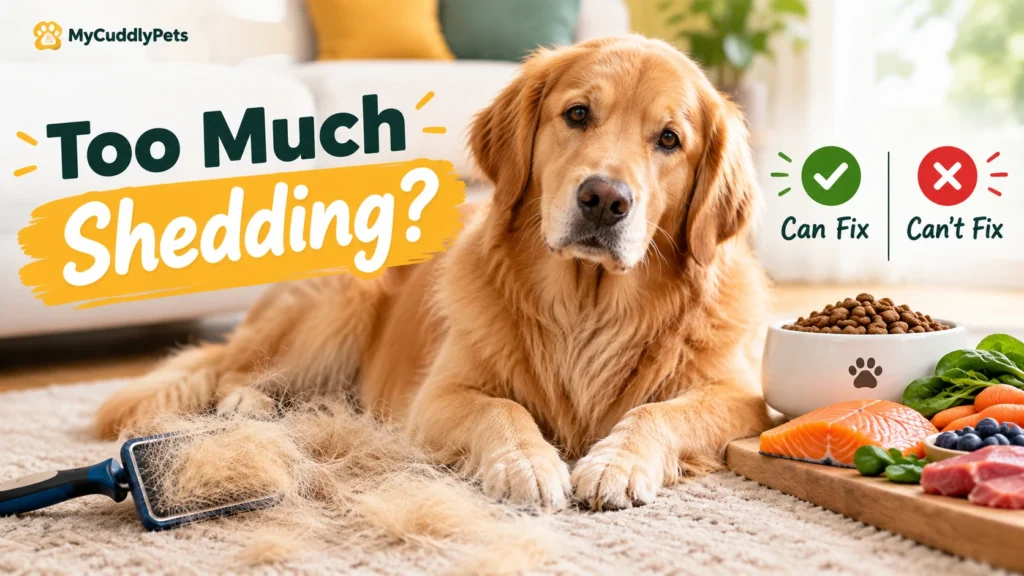
Quick answer: Diet can meaningfully reduce excessive shedding when a dog’s current food is low in quality protein or fatty acids, but it won’t stop normal, healthy shedding altogether. Look for a food with a named animal protein first on the label, added omega-3 and omega-6 fatty acids, and zinc, biotin, and vitamin E — then give it 8 to 12 weeks to show results.
Key Takeaways
- Some shedding is normal and seasonal; food changes won’t eliminate it, only excess shedding tied to nutrition can improve.
- Omega-3 (EPA/DHA) and omega-6 fatty acids are the nutrients most consistently linked to coat quality and reduced shedding.
- A coat change from a new food takes 8 to 12 weeks, roughly matching one hair growth cycle — patience matters more than switching foods repeatedly.
- Sudden hair loss, bald patches, or shedding with itching and redness point to something beyond diet and deserve a vet visit.
- Always transition to a new food gradually over 7 to 10 days to avoid digestive upset that can mask or worsen coat problems.
If you’re finding fur on every piece of furniture and wondering whether the food in your dog’s bowl is part of the problem, you’re asking a reasonable question. I’m James Walker, and like a lot of dog owners, I’ve spent time comparing labels, reading ingredient lists, and figuring out which claims about “skin and coat” formulas are actually backed by anything. This article walks through what shedding is, why it happens, which nutrients genuinely support a healthy coat, and how to choose and feed a food that gives your dog’s skin and coat the best chance — without overpromising what nutrition alone can do.
Table of Contents
- What Is “Dog Food for Shedding,” Really?
- Why Do Dogs Shed So Much?
- How Nutrition Affects Shedding and Coat Health
- Which Ingredients Matter Most for a Shedding Dog?
- How to Choose the Right Dog Food for Shedding
- How Much and How Often Should You Feed?
- How to Transition to a New Dog Food
- Common Mistakes Dog Owners Make
- Shedding-Related Problems and What to Do
- Dry vs. Wet Food for Shedding
- Special Considerations
- When Should You Talk to a Veterinarian?
- Frequently Asked Questions
- Related Reading
- Final Takeaway
This article is for general informational purposes and reflects publicly available nutrition guidance. It isn’t a substitute for personalized veterinary advice — always check with your vet about your dog’s specific needs.
What Is “Dog Food for Shedding,” Really?
“Dog food for shedding” isn’t an official food category — you won’t find that phrase defined by any regulatory body. In practice, it refers to a regular, complete and balanced dog food that’s formulated with extra attention to skin and coat health, usually through added fatty acids, zinc, biotin, and high-quality animal protein. These foods are sometimes labeled “skin and coat” or “sensitive skin and stomach” formulas.
The label matters here: a complete and balanced food is one that meets the nutrient minimums (and some maximums) set out in the AAFCO Dog Food Nutrient Profiles, either by formulation or by feeding trial. A “skin and coat” formula should still meet that baseline — the coat-focused ingredients are additions on top of, not a substitute for, complete nutrition.
It’s worth setting expectations early: no food will make a healthy, normally shedding dog stop shedding. What the right food can do is address excess shedding that’s actually caused by a nutritional gap — dry skin, a dull coat, or brittle hair from a diet that’s short on the fats and micronutrients skin cells and hair follicles need.
Why Do Dogs Shed So Much?
Shedding is the normal process of a dog’s hair follicles cycling out old hair to make room for new growth. Several factors drive how much and how often a dog sheds, and diet is only one of them:
- Breed and coat type. Double-coated breeds (like Labradors, German Shepherds, and Huskies) shed heavily, especially during seasonal “coat blow” in spring and fall.
- Season and daylight. Changing daylight hours trigger coat-cycle shifts even in climate-controlled homes.
- Age. Puppies lose their soft puppy coat as the adult coat comes in; senior dogs’ coats can thin or become drier.
- Health status. Parasites, hormonal conditions, allergies, and stress can all increase shedding independent of food.
- Nutrition. A diet that’s low in quality protein, essential fatty acids, or certain micronutrients can leave the coat dry, brittle, and more prone to excess shedding.
Because so many of these factors overlap, diet is rarely the only answer — but when a dog’s current food is nutritionally thin, it’s often the easiest factor to fix.
How Nutrition Affects Shedding and Coat Health
Hair is made mostly of protein, and skin renews itself constantly — both processes are nutrient-hungry. When a diet falls short, the coat is often one of the first places it shows.
- Protein and amino acids: Hair is roughly 90% protein (keratin), so a diet needs enough high-quality, digestible protein to support ongoing hair growth. Under the AAFCO Adult Maintenance profile, dog food must contain at least 18% crude protein on a dry matter basis; growing puppies need more.
- Fat and fatty acids: Dietary fat carries fat-soluble vitamins and supplies the fatty acids that make up the skin’s protective barrier. Omega-3 fatty acids (EPA and DHA, mainly from fish) help calm irritation and support a glossy coat, while omega-6 fatty acids (like linoleic acid, from chicken fat, sunflower oil, and flaxseed) help reinforce the skin’s moisture barrier.
- Vitamins and minerals: Zinc supports skin cell turnover and wound healing; biotin (a B vitamin) supports keratin production; vitamin A supports normal skin cell development; vitamin E is an antioxidant that helps protect skin cells from damage.
- Moisture and hydration: Dry skin sheds and flakes more. Adequate water intake — and, for some dogs, a partly wet diet — supports skin hydration from the inside.
- Digestibility: A highly digestible diet means more of those nutrients are actually absorbed rather than passing through. Low-digestibility foods can leave a dog nutritionally short even if the label numbers look fine.
The FDA notes that a “complete and balanced” claim means a food has been verified to meet an established nutrient profile — a useful baseline check before looking at any coat-specific extras.
Which Ingredients Matter Most for a Shedding Dog?
No single ingredient is magic, and none should be judged as automatically good or bad — context matters. Here’s what to know about the ones most often linked to coat health:
- Salmon and other fatty fish: A strong natural source of omega-3 EPA and DHA. Often used as the first ingredient in skin-and-coat formulas. Not necessary if a food already includes fish oil in adequate amounts.
- Fish oil: A concentrated omega-3 source added to many formulas specifically for skin and coat support. Look for it named directly rather than a vague “animal fat.”
- Flaxseed: Provides plant-based omega-3 (ALA), which dogs convert to EPA/DHA less efficiently than fish-based omega-3 — useful as a supplement, not usually a full replacement for fish oil.
- Chicken, turkey, or lamb (named meat): Quality animal protein for hair growth and muscle maintenance. “Named” meat (e.g., “chicken”) is more transparent than vague terms like “meat meal” or “animal by-product.”
- Sunflower oil and chicken fat: Common omega-6 sources that support the skin’s moisture barrier; useful alongside, not instead of, omega-3s.
- Sweet potato and oats: Digestible carbohydrate/fiber sources that support stool quality and steady energy — indirectly relevant since digestive upset and nutrient malabsorption can affect coat condition.
Ingredients that are sometimes marketed as shedding solutions — like generic “grain-free” formulations — aren’t automatically better for coat health. Grain-free only matters if a dog has a specific, ideally vet-confirmed, sensitivity; otherwise, the fatty acid and protein profile matters far more than whether grains are present.
How to Choose the Right Dog Food for Shedding
Work through these factors in order, before worrying about brand reputation or price:
- Life stage suitability: Confirm the food is labeled for your dog’s life stage (puppy, adult, senior, or “all life stages”).
- Complete and balanced statement: Check for an AAFCO nutrient-profile or feeding-trial statement on the label.
- Named protein source: Look for a specific animal protein as the first ingredient.
- Fatty acid content: Check the guaranteed analysis for added omega-3 and omega-6 sources — not just total fat percentage.
- Micronutrients: Zinc, biotin, and vitamin E should appear in the ingredient list if the food is marketed for skin/coat support.
- Digestive tolerance: Note your dog’s current stool quality and appetite as a baseline so you can judge whether a new food is actually agreeing with them.
- Known allergies or intolerances: Avoid any ingredient your dog has reacted to before.
- Calorie density and your dog’s body condition: A richer, higher-fat formula may need smaller portions to avoid weight gain.
Only after covering those should you weigh format (dry, wet, or a mix) and budget. A nutritionally sound, moderately priced food fed consistently will usually do more for a coat than an expensive food that gets swapped out every few weeks.
How Much and How Often Should You Feed?
Portion needs vary by weight, activity level, age, and the specific food’s calorie density, so treat any general chart as a starting range — not a prescription.
| Dog’s Weight | Approximate Daily Amount (dry food) | Typical Meals per Day |
|---|---|---|
| 10–20 lb | 3/4 – 1 1/4 cups | 2 |
| 21–50 lb | 1 1/4 – 2 1/2 cups | 2 |
| 51–90 lb | 2 1/2 – 4 cups | 2 |
| 90+ lb | 4 – 5+ cups | 2 (sometimes 3) |
These ranges are general starting points; your dog’s actual calorie needs depend on activity, metabolism, and body condition, so use the specific food’s own feeding guidelines and check in with your vet to fine-tune the amount. Feeding twice a day is typical for adult dogs; puppies usually need three to four smaller meals. Keep treats to no more than about 10% of daily calories so they don’t crowd out the nutrients from the main diet — including the fatty acids doing the coat-health work.
How to Transition to a New Dog Food
Switching foods abruptly can cause digestive upset, which can mask whether a new food is actually helping the coat. A gradual transition also gives you a cleaner read on results.
- Days 1–3: Mix about 25% new food with 75% current food.
- Days 4–6: Move to a 50/50 mix.
- Days 7–9: Shift to about 75% new food, 25% old food.
- Day 10 onward: Feed 100% new food.
Some loose stool or reduced appetite in the first few days can be normal as the gut adjusts. Slow the transition down (spend more days at each ratio) if you see ongoing diarrhea, vomiting, or a dog refusing to eat. Give the new food a full 8 to 12 weeks before judging its effect on shedding — that’s roughly how long one hair growth cycle takes.
Common Mistakes Dog Owners Make
- Switching foods too often. Constant changes never give any one food enough time (or a fair digestive baseline) to show whether it’s helping.
- Judging results too early. Coat changes take weeks, not days.
- Focusing on marketing terms over nutrients. “Grain-free,” “natural,” and “premium” aren’t guarantees of better fatty acid content.
- Ignoring calorie density. A richer food fed at the old portion size can cause weight gain, which brings its own coat and health issues.
- Over-relying on treats or table scraps. These dilute the nutrient balance of an otherwise well-formulated diet.
- Assuming diet alone will fix shedding caused by allergies, parasites, or a medical condition. Diet helps with nutrition-related coat issues, not every cause of hair loss.
Shedding-Related Problems and What to Do
| Problem | Possible Reason | Practical Step | When to See a Vet |
|---|---|---|---|
| Dull, dry coat with normal shedding amount | Diet may be low in fatty acids or overall fat | Check the label for added omega-3/omega-6; consider a food or vet-approved fish oil supplement | If no improvement after 8–12 weeks |
| Sudden increase in shedding | Season change, stress, recent food switch, or an underlying issue | Note timing and any other changes; keep the current food consistent for now | If shedding is severe or sudden with no clear trigger |
| Shedding plus itching or redness | Possible allergy (food or environmental), parasites, or skin infection | Rule out fleas; avoid switching foods repeatedly, which can complicate an elimination diet | Promptly — this combination usually needs veterinary evaluation |
| Bald patches or hair loss in specific spots | Not typical shedding — could be a skin condition, hormonal issue, or parasite | Don’t attempt to treat with diet alone | Yes, as soon as possible |
| Shedding with loose stool after a food change | Transition happened too quickly, or the new food doesn’t agree with the dog | Slow the transition or return to the previous food and consult your vet on alternatives | If diarrhea persists more than 2–3 days |
Dry vs. Wet Food for Shedding
| Factor | Dry Food (Kibble) | Wet Food (Canned) |
|---|---|---|
| Fatty acid delivery | Can be fortified with fish oil, though fats degrade faster once a bag is opened | Often higher in fat and moisture per calorie; oils are less exposed to air until opened |
| Moisture content | Roughly 10%; relies on separate water intake for skin hydration | Roughly 75–80%; contributes directly to hydration |
| Cost per feeding | Generally lower | Generally higher |
| Shelf life after opening | Weeks, if sealed properly | Days, refrigerated |
| Best fit | Everyday feeding, dogs who tolerate kibble well | Dogs who need more moisture, pickier eaters, or as a mixer with dry food |
Neither format is inherently better for shedding — what matters most is the fatty acid and protein content of the specific product. Some owners mix a small amount of wet food into a fatty-acid-rich dry diet to boost palatability and moisture without changing the overall nutrient profile much.
Special Considerations
Puppies
Puppies lose their soft puppy coat as the adult coat grows in — this is normal and not something to “fix” with a coat-specific diet. Puppies need a food formulated for growth, with higher protein and fat than an adult maintenance diet.
Senior Dogs
Coats can naturally thin and become drier with age. Senior dogs may benefit from slightly higher-quality fat sources, but any major increase in shedding in an older dog is worth mentioning at the next vet visit, since it can overlap with age-related health changes.
Double-Coated Breeds
Breeds with a dense undercoat (Huskies, German Shepherds, Golden Retrievers) will shed heavily during seasonal coat blow regardless of diet quality. Good nutrition supports the coat that’s there; it won’t prevent the seasonal shed itself.
Sensitive-Stomach Dogs
Dogs prone to loose stool may need a more gradual transition and a limited-ingredient formula to isolate whether a specific protein or additive is the trigger, especially if shedding is paired with digestive symptoms.
When Should You Talk to a Veterinarian?
Diet is a reasonable first adjustment for mild, nutrition-linked shedding, but certain signs point beyond food:
- Bald patches or uneven hair loss rather than general shedding
- Shedding combined with intense itching, redness, or skin sores
- Sudden, dramatic increase in shedding with no seasonal or dietary trigger
- Accompanying symptoms like lethargy, appetite changes, or weight change
- No improvement after a properly transitioned, nutritionally sound diet over 8–12 weeks
These patterns can point to allergies, parasites, hormonal conditions, or skin infections that need veterinary diagnosis rather than a food swap. This article can’t diagnose your dog — a vet exam is the right next step for any of the signs above.
Frequently Asked Questions
Can changing dog food really stop shedding?
It can reduce excess shedding caused by a nutritional gap, but it won’t stop the normal, healthy shedding every dog does as part of its hair growth cycle.
How long does it take to see a coat improvement after switching foods?
Plan on 8 to 12 weeks, since that roughly matches one hair growth cycle. Shorter trials often lead to switching foods before a fair result shows.
Is fish oil enough on its own, or does the whole food matter?
Fish oil (or a fish-based food) helps with the omega-3 side, but overall protein quality, omega-6 balance, and micronutrients like zinc and biotin all contribute — a single supplement can’t fully compensate for a nutritionally weak base diet.
Does grain-free food reduce shedding?
Not inherently. Grain-free only helps if a dog has a confirmed grain sensitivity; otherwise the fatty acid and protein content of the food matters far more than whether it contains grain.
Should I switch to wet food if my dog sheds a lot?
Not necessarily. Wet food adds moisture, which can help skin hydration, but a dry food with strong fatty acid content can be just as effective for coat health.
Can a food allergy cause shedding?
A true food allergy is more likely to cause itching, skin inflammation, or gastrointestinal symptoms, with hair loss as a secondary effect from scratching — it’s worth ruling out with a vet rather than self-diagnosing through repeated food switches.
Is expensive dog food always better for shedding?
No. Price doesn’t guarantee better fatty acid or protein content — check the guaranteed analysis and ingredient list rather than assuming cost reflects quality.
How much fish oil is safe to add to my dog’s food?
Dosing depends on your dog’s weight and the product’s concentration, and too much can cause digestive upset or affect blood clotting, so this is worth confirming with your vet rather than estimating.
Why is my dog still shedding a lot even on a good food?
Some dogs, especially double-coated breeds, shed heavily on a seasonal cycle no matter how well they eat. If shedding is otherwise normal (no bald spots, itching, or skin changes), it may simply be their coat cycle rather than a diet issue.
Note for readers: some search engines have scaled back visible FAQ snippets in results, but this section still reflects the genuine, most-asked questions on this topic.
Final Takeaway
Nutrition can meaningfully reduce shedding that’s caused by a diet low in quality protein, fatty acids, or key micronutrients — but it won’t eliminate the normal, seasonal shedding that’s simply part of having a dog. Look for a complete and balanced food with a named animal protein, added omega-3 and omega-6 fatty acids, and zinc, biotin, and vitamin E; transition to it gradually; and give it a full 8 to 12 weeks before judging the result. If shedding comes with itching, bald patches, or other symptoms, treat that as a signal to see your vet rather than to keep switching foods.
