
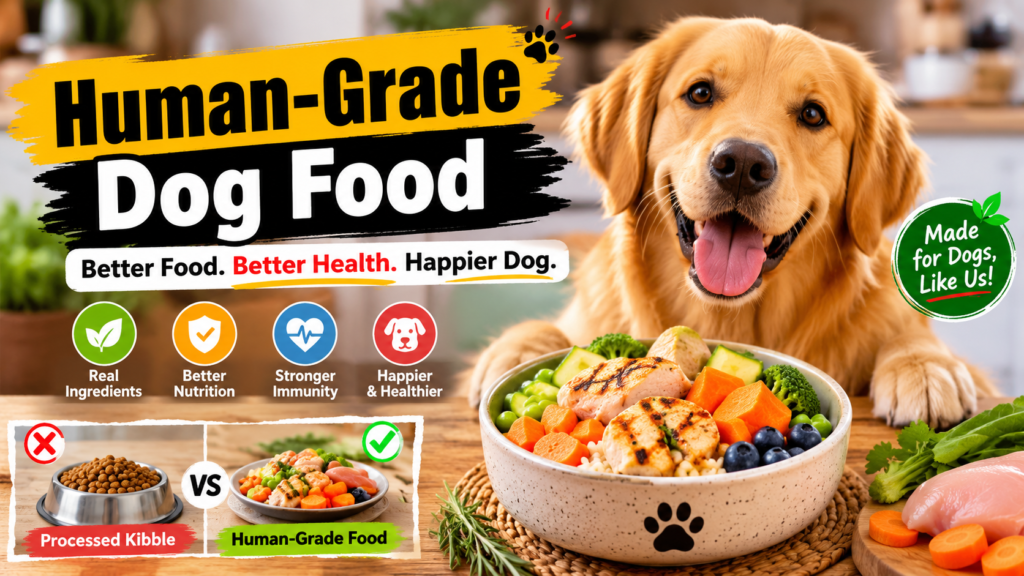
Quick Answer: Human-grade dog food is made with ingredients and in facilities that meet the same safety standards as food for people, following AAFCO’s official definition. It’s not just marketing — it means every ingredient could legally be sold for human consumption. Most everyday kibble and canned food are safe but don’t meet this stricter standard.
I still remember the first time a client asked me, “Is this stuff really safe enough for me to eat?” Good question. Most dog owners hear “human-grade” on a bag and assume it just means better quality. It’s actually a specific, regulated term. I’m Michael Hayes, and I’ve spent years helping owners sort real nutrition claims from clever labeling. Let’s break down what human-grade dog food really means, when it’s worth it, and how to switch without upsetting your dog’s stomach.
What Does “Human-Grade” Actually Mean?
“Human-grade” isn’t a vague marketing phrase. It’s a legal term with real requirements behind it.
The AAFCO Human-Grade Standard
According to AAFCO (the Association of American Feed Control Officials), a food can only be labeled human-grade if every ingredient is edible for humans under federal regulations, and the food is manufactured, packed, and held in a USDA-licensed facility. If even one ingredient doesn’t meet that bar, the whole product loses the label.
Human-Grade vs. Feed-Grade vs. “Premium”
Feed-grade ingredients are approved for animal consumption but wouldn’t pass inspection for human food. “Premium,” “gourmet,” and “natural” are marketing terms with no legal definition, so they don’t guarantee anything close to human-grade standards. Human-grade is the only one of these terms that’s actually regulated.
Why Human-Grade Dog Food Matters
Ingredient Sourcing and Quality Control
Because human-grade facilities follow USDA oversight, there’s tighter control over contamination, ingredient freshness, and sourcing. That doesn’t mean feed-grade food is unsafe — it just means human-grade food has an extra layer of accountability built in.
Digestibility and Everyday Energy
In my experience, dogs on higher-quality, minimally processed diets often produce smaller, firmer stools and seem to have steadier energy through the day. This isn’t universal — every dog’s gut responds differently — but it’s one of the most common changes owners report.
How to Switch Your Dog to Human-Grade Food (Step-by-Step)
- Start slow. Mix 25% new food with 75% current food for two to three days.
- Increase gradually. Move to a 50/50 mix for another two to three days.
- Shift the ratio. Go to 75% new food, 25% old food.
- Complete the switch. Feed 100% human-grade food once stools look normal.
- Watch and adjust. If you see loose stools at any stage, slow down and hold at that ratio a few extra days.
Common Problems When Switching Foods (and How to Fix Them)
| Symptom | Likely Cause | Fix |
|---|---|---|
| Loose stool or diarrhea | Switching too quickly | Slow the transition down over 7–10 days instead of a few days |
| Refusing to eat | Unfamiliar texture or smell | Warm the food slightly or mix in a small amount of low-sodium broth |
| Excess gas | New fiber or protein sources | Give the gut 1–2 weeks to adjust before changing food again |
| Weight gain | Feeding by old portion sizes | Recalculate portions using the new food’s calorie density |
Common Mistakes Owners Make
- Switching foods overnight instead of gradually
- Assuming “human-grade” and “human food” are the same thing (they’re not — seasoning, onions, and certain fats used in human cooking are still unsafe for dogs)
- Using the old food’s feeding chart instead of the new food’s calorie guidelines
- Judging the switch after only two or three days
Human-Grade vs. Regular Dog Food: What’s the Difference?
| Factor | Human-Grade Dog Food | Regular (Feed-Grade) Dog Food |
|---|---|---|
| Ingredient standard | Must be edible for humans | Approved for animal consumption only |
| Facility requirement | USDA-licensed human food facility | Feed-mill facility |
| Typical cost | Higher | Lower to moderate |
| Shelf life | Often shorter, especially fresh/refrigerated formats | Usually longer, shelf-stable |
| Labeling regulation | Strictly defined by AAFCO | Less strictly regulated wording |
Pro Tips for Feeding Human-Grade Dog Food
- Check the calorie count per cup or ounce — human-grade formulas are often more calorie-dense, so you may need to feed less than you’re used to.
- Store fresh or refrigerated human-grade food properly; it typically has a shorter shelf life than shelf-stable kibble.
- Introduce it alongside your dog’s regular vet checkups so you can track how their weight and digestion respond over time.
- Don’t assume more expensive automatically means better for your specific dog — match the food to your dog’s life stage and any health needs.
FAQ
Is human-grade dog food worth the extra cost?
For many owners, yes — especially for dogs with sensitive stomachs. But regular, AAFCO-complete dog food can still be perfectly healthy, so it depends on your budget and your dog’s needs.
Can all dogs eat human-grade food?
Most healthy dogs can, but dogs with specific medical conditions should only switch foods under veterinary guidance.
Does human-grade dog food expire faster?
Often yes, particularly fresh or refrigerated formulas. Always check storage instructions on the packaging.
How do I switch my dog to human-grade food without stomach issues?
Transition gradually over 7–10 days, mixing increasing amounts of the new food with the old food.
Is human-grade the same as human food?
No. Human-grade means the ingredients meet human food safety standards — it doesn’t mean you should feed your dog directly from your plate, since many human foods and seasonings are unsafe for dogs.
Should senior dogs eat human-grade food?
Many senior dogs benefit from easily digestible, high-quality ingredients, but calorie needs change with age, so check with your vet on portioning.
Why do some vets recommend human-grade dog food?
Some vets recommend it for dogs with digestive sensitivities or allergies, since ingredient sourcing and quality control tend to be more consistent.
Conclusion
Human-grade dog food isn’t a magic fix, but it is a real, regulated standard — not just a marketing buzzword. If you’re considering the switch, go slow, watch how your dog’s digestion responds, and check in with your vet if anything seems off. For more general pet health guidance, resources like PetMD and the American Veterinary Medical Association are good places to learn more.
