
Written by Daniel Carter · Last updated: October 1, 2026
Quick Answer: Signs of an aggressive puppy may include stiff body posture, intense staring, growling, snarling, snapping, lunging, and forceful biting. However, not every puppy that bites or growls is aggressive. Understanding your puppy’s body language, identifying triggers, and seeking professional help when necessary can help prevent injuries and address concerning behavior early.
Key Takeaways
- Playful biting is common in puppies, but stiff body language, repeated snapping, and fearful reactions may indicate a more serious problem.
- Growling, showing teeth, and snapping are warning signals that should never be ignored or punished.
- Fear, anxiety, frustration, pain, and resource guarding can contribute to aggressive behavior.
- Use safe management and reward-based training instead of physical punishment.
- Consult a veterinarian if your puppy displays repeated aggression, bites forcefully, or suddenly changes behavior.
Recognizing the signs of an aggressive puppy can be challenging, especially for first-time dog owners. Puppies naturally explore their surroundings with their mouths, play roughly, and sometimes growl during games. However, certain behaviors may indicate fear, frustration, or a developing aggression problem.
As a pet-care writer, I believe understanding the difference between normal puppy behavior and concerning warning signs is an important part of responsible puppy ownership. This guide explains what to watch for, why aggressive behavior may develop, and how to respond safely.
Disclaimer: This article is for general informational purposes and reflects publicly available veterinary behavior guidance. It isn’t a substitute for personalized veterinary advice. Always consult your veterinarian about your puppy’s specific needs.
What Are the Signs of an Aggressive Puppy?

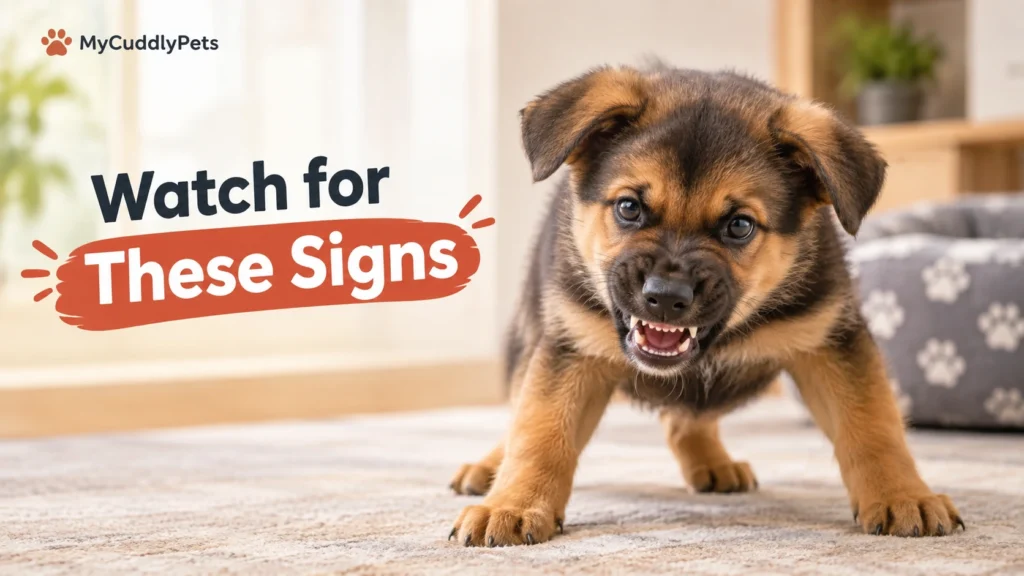
An aggressive puppy may display several warning signals through body language, facial expressions, vocalizations, and physical actions. Some puppies show subtle signs of discomfort before growling or biting, while others may escalate quickly.
1. Frequent Growling and Snarling
Growling is one of the most recognizable warning signals in dogs. A puppy may growl when frightened, uncomfortable, frustrated, or protective of something valuable.
Pay attention to the circumstances surrounding the growling. A puppy that growls during relaxed play may be communicating excitement. However, a puppy that growls with a stiff body when someone approaches its food or tries to pick it up may be expressing distress.
Snarling, particularly when accompanied by exposed teeth and tense facial muscles, is another warning sign. Repeated snarling during ordinary interactions deserves professional attention.
2. Stiff or Frozen Body Posture
A puppy that suddenly becomes rigid or freezes during an interaction may be experiencing significant stress or discomfort.
Watch for these signs:
- Standing unusually still with tense muscles.
- Holding the head and neck rigidly.
- Leaning forward with a tense body.
- Keeping the mouth tightly closed.
- Remaining motionless while staring at someone.
Freezing can be an important early warning signal. If your puppy suddenly becomes stiff when approached, stop what you are doing and give it space.
3. Intense Staring and Whale Eye
A hard, sustained stare can indicate that a puppy feels threatened or is guarding something. Another possible warning sign is whale eye, which occurs when a dog turns its head while showing the whites of its eyes.
These signals are especially important when your puppy is eating, chewing a toy, resting, or interacting with another dog.
However, eye contact alone does not prove aggression. Consider the puppy’s entire body language and the situation.
4. Snapping and Showing Teeth
Snapping occurs when a puppy quickly closes its jaws toward a person or animal, sometimes without making contact. Showing teeth may accompany this behavior.
These actions can indicate that the puppy wants an interaction to stop. Repeated snapping, particularly during handling or when someone approaches its belongings, should be taken seriously.
Never deliberately provoke a puppy to see whether it will snap. Instead, prevent situations that have previously triggered the behavior and seek professional guidance.
5. Lunging and Charging
A puppy that suddenly lunges toward a person or another animal may be reacting to fear, frustration, or another trigger.
Some puppies bark and lunge when restrained by a leash. Others react when unfamiliar people approach their resting area.
Lunging does not automatically establish the motivation behind the behavior. Nevertheless, it creates a potential injury risk and should be managed carefully.
6. Repeated, Forceful Biting
Puppies commonly use their mouths during play and exploration. However, repeated forceful biting, especially when accompanied by a rigid posture, growling, or snapping, may indicate a more serious behavioral concern.
Pay attention to whether the puppy can disengage from play, responds to pauses, and relaxes when given space.
Bites that break the skin, repeated attacks, or biting during ordinary handling warrant professional assessment.
Playful Biting vs. Aggressive Biting
One of the most common questions puppy owners ask is whether biting is normal or a sign of aggression. The distinction is not always obvious because puppies can growl, chase, and bite during ordinary play.
| Behavior | Playful Biting | Potential Aggression |
|---|---|---|
| Body posture | Usually loose and relaxed | May become stiff or frozen |
| Facial expression | Often relaxed | May show facial tension or exposed teeth |
| Growling | May occur during play | May occur with stiffness or defensive behavior |
| Biting | Often gentle or inhibited | May be forceful or repeated |
| Response to breaks | May settle when play stops | May continue snapping or struggling |
| Common triggers | Excitement and play | Fear, frustration, handling, or guarding |
This comparison is a general guide, not a diagnostic test. A puppy may display a mixture of playful and concerning behaviors, and the same behavior can have different motivations in different situations.
For additional guidance, see the ASPCA’s guide to puppy mouthing, nipping, and biting.
Why Do Puppies Show Aggressive Behavior?
Puppy aggression can develop for several reasons. Identifying the circumstances surrounding the behavior is an important first step toward addressing it.
Fear and Anxiety
Fear is a common motivation for aggressive behavior in dogs. A puppy may feel threatened by unfamiliar people, sudden movements, loud noises, or uncomfortable handling.
For example, a puppy that has previously experienced frightening interactions may growl or snap when someone approaches too quickly. These reactions may be attempts to increase distance from something frightening.
Resource Guarding
Some puppies become uncomfortable when people or other animals approach valuable resources, such as food, toys, chews, or resting places.
Signs may include freezing over a food bowl, growling when someone approaches a chew, or snapping when another animal tries to take a toy.
Do not repeatedly take food or toys away to test your puppy. Such actions can increase stress and create opportunities for bites.
Frustration and Overstimulation
Puppies can become frustrated when they cannot reach something they want or when an exciting interaction becomes overwhelming.
For example, a puppy restrained by a leash may bark and lunge toward another dog. A puppy that becomes excessively excited during rough play may also begin biting more forcefully.
Providing appropriate breaks and avoiding overwhelming situations can help reduce these risks.
Poor or Inadequate Socialization
Early experiences help puppies learn how to respond to unfamiliar people, animals, sounds, and environments.
Puppies that have limited positive experiences or have experienced frightening encounters may become fearful in unfamiliar situations. Some may respond by avoiding people, barking, growling, or snapping.
Socialization should be gradual and positive. Forcing a frightened puppy to interact with unfamiliar dogs or people may make the situation worse.
Pain or Medical Problems
Pain and certain medical problems can contribute to sudden behavioral changes. A puppy that previously tolerated handling may begin growling or snapping when touched if it is experiencing discomfort.
If aggression appears suddenly, particularly when your puppy is picked up, touched, or moved, arrange a veterinary examination to investigate possible medical causes.
How to Respond to an Aggressive Puppy
When a puppy displays concerning behavior, your immediate priority should be preventing injuries and reducing the situation’s intensity.
1. Give Your Puppy Space
If your puppy growls, freezes, or snaps, stop the interaction and calmly create distance when it is safe to do so.
Avoid cornering, chasing, grabbing, or forcing your puppy to remain in a frightening situation. Allow it to move away whenever possible.
2. Identify the Trigger
Observe what happened immediately before the behavior. Consider whether your puppy was eating, sleeping, playing, being handled, or interacting with another animal.
Record the circumstances, including the location, people involved, body language, and behavior that followed. These observations can help your veterinarian or behavior specialist assess the problem.
3. Use Reward-Based Training
Reward-based training focuses on encouraging behaviors you want to see. Depending on your puppy’s needs, a qualified professional may recommend rewarding calm behavior, teaching alternative responses, or gradually introducing manageable situations.
Training should take place at a level your puppy can comfortably handle. Do not deliberately expose your puppy to situations that provoke aggressive reactions.
4. Manage Food and Toys Safely
If your puppy guards food or toys, prevent children and other pets from approaching while it is eating or chewing.
Provide a quiet feeding area and avoid reaching into the puppy’s bowl or forcibly removing valuable objects. A professional can teach you a safe management and behavior modification plan.
5. Avoid Physical Punishment
Hitting, shouting, pinning a puppy down, or forcibly holding its mouth shut can increase fear and may worsen aggressive responses.
Never punish growling. Growling is communication that your puppy is uncomfortable. Punishing the warning may make it harder to recognize when your puppy is distressed.
Instead, calmly interrupt the situation when safe and seek appropriate behavioral guidance.
Common Mistakes to Avoid
- Assuming every bite is aggression: Normal puppy play often includes mouthing. Consider the entire behavioral context.
- Ignoring repeated warning signs: Frequent snapping, stiffening, or fearful reactions should be assessed rather than dismissed.
- Punishing growling: Punishment can increase fear and does not address the underlying cause.
- Forcing social interactions: A frightened puppy should not be forced to approach unfamiliar people or dogs.
- Taking away food to test behavior: Repeatedly disturbing a puppy while eating may increase guarding and create bite risks.
- Waiting for the puppy to grow out of aggression: Concerning behavior may persist or worsen without appropriate management and professional guidance.
When Should You Contact a Veterinarian?
Contact your veterinarian if your puppy repeatedly growls, snaps, lunges, or bites in situations that are not clearly playful. Early professional assessment can help identify contributing medical or behavioral factors.
Arrange a prompt veterinary examination if your puppy:
- Suddenly becomes aggressive or unusually irritable.
- Growls or snaps when touched or picked up.
- Repeatedly bites people or other animals.
- Shows intense fear, persistent avoidance, or frequent attempts to escape.
- Displays aggression that is becoming more frequent or severe.
If a bite causes a puncture wound or significant injury, seek appropriate medical care for the injured person or veterinary care for an injured animal.
Your veterinarian may recommend a qualified veterinary behaviorist or an experienced, reward-based trainer who has specific expertise in aggression and fear-related behavior.
The UC Davis School of Veterinary Medicine’s puppy nipping guide also explains why recognizing concerning biting behavior and seeking professional advice matter.
Frequently Asked Questions
1. What are the first signs of an aggressive puppy?
Early warning signs may include freezing, a stiff body, intense staring, lip lifting, growling, or repeatedly trying to avoid an interaction. These behaviors should be interpreted in context rather than individually.
2. Is it normal for puppies to growl while playing?
Yes. Puppies may growl during normal play. A relaxed body and an ability to pause or disengage can help distinguish ordinary play from concerning behavior. However, growling accompanied by stiffness or forceful biting warrants closer attention.
3. Why does my puppy suddenly bite me aggressively?
Possible reasons include fear, frustration, overstimulation, resource guarding, or pain. If the behavior begins suddenly, consult your veterinarian to check for medical causes.
4. Can an aggressive puppy become a friendly adult dog?
Some puppies improve with appropriate management and behavior modification. However, outcomes depend on the underlying cause, the puppy’s experiences, and the individual situation. Early professional guidance can help.
5. Should I punish my puppy for growling?
No. Growling is a warning signal that your puppy may be uncomfortable. Punishing it can increase fear and may make future interactions less predictable. Instead, calmly create distance and investigate the trigger.
6. How can I tell if my puppy is playing or being aggressive?
Look at the whole interaction. Play often involves a relaxed body and opportunities to pause. Concerning aggression may involve stiffness, intense staring, repeated snapping, or forceful biting. No single behavior provides a definitive diagnosis.
7. Can poor socialization cause puppy aggression?
Inadequate or frightening early experiences may contribute to fear and reactive behavior. Gradual, positive exposure to appropriate experiences can help puppies develop confidence, but a fearful puppy should never be forced into interactions.
8. When should I seek professional help for puppy aggression?
Seek professional advice if your puppy repeatedly growls, snaps, lunges, bites forcefully, or shows intense fear. A veterinarian can assess possible medical causes and recommend an appropriate behavior specialist.
Final Takeaway
Recognizing the signs of an aggressive puppy starts with understanding body language and the circumstances surrounding each behavior. Stiff posture, intense staring, repeated snapping, forceful biting, and growling during uncomfortable interactions can all be important warning signs.
Not every puppy that bites or growls is aggressive. However, repeated or escalating behavior deserves attention. Give your puppy space, avoid punishment, identify potential triggers, and consult a veterinarian when necessary. Early, appropriate support can help you create a safer environment for your puppy and everyone around it.