
Written by James Walker · Last updated: October 1, 2026
Quick Answer: The major types of dog aggression include fear-related, territorial, resource-guarding, predatory, frustration-related, redirected, and pain-related aggression. Dogs may also display protective, maternal, or social conflict-related aggression. Identifying the context and triggers helps owners understand the behavior and manage it safely.
Key Takeaways
- Dog aggression is a broad category of behavior, not a single diagnosis.
- Fear, anxiety, resource guarding, frustration, pain, and territorial situations can contribute to aggressive behavior.
- Dogs may show more than one type of aggression, and the same behavior can have different underlying causes.
- Avoid deliberately provoking your dog or punishing warning signals such as growling.
- Sudden, severe, or escalating aggression warrants veterinary attention and may require professional behavioral support.
Understanding the types of dog aggression can help you recognize what your dog may be communicating. A dog that growls when someone approaches its food bowl may have a different motivation from a dog that lunges at unfamiliar dogs during walks. Both behaviors may look aggressive, but their triggers and management needs can differ.
In this guide, I explain the major types of dog aggression, their possible causes, common warning signs, and practical ways to manage them. My goal is to help dog owners recognize behavioral patterns without making assumptions or putting themselves, their families, or their pets at risk.
Table of Contents
- What Are the Types of Dog Aggression?
- What Causes Different Types of Dog Aggression?
- How Dog Behavior and Nutrition Can Affect Aggression
- Which Types of Dog Aggression Matter Most?
- How to Identify the Type of Aggression Your Dog Is Showing
- How to Manage Aggression Safely
- Common Mistakes Dog Owners Make
- Types of Dog Aggression Problems and What to Do
- Comparing Different Types of Dog Aggression
- Special Considerations
- When Should You Talk to a Veterinarian?
- Frequently Asked Questions
- Related Reading
- Final Takeaway
This article is for general informational purposes and reflects publicly available behavior and nutrition guidance. It isn’t a substitute for personalized veterinary or behavioral advice — always check with your vet or a qualified behavior professional about your dog’s specific needs.
What Are the Types of Dog Aggression?
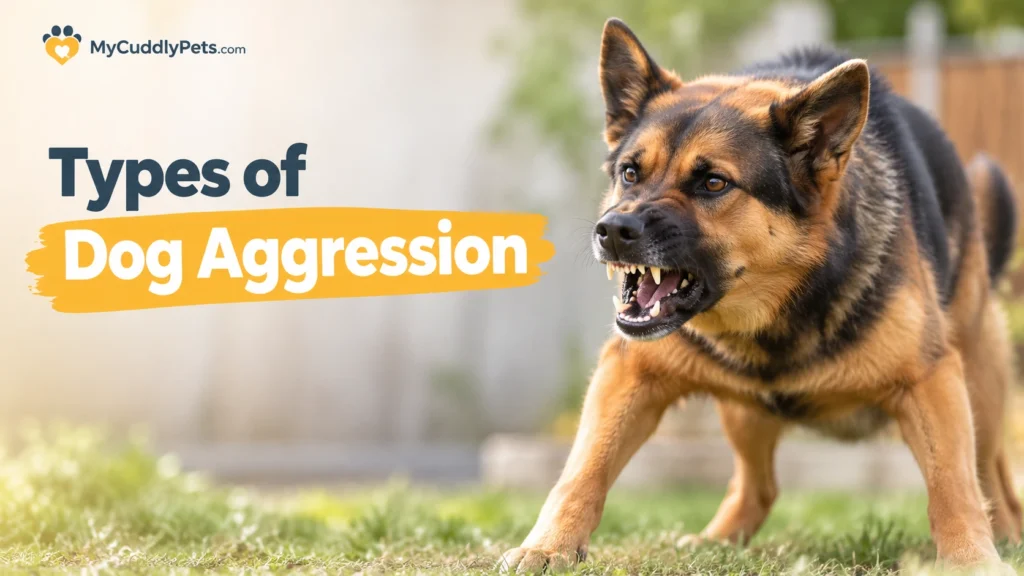
Dog aggression is a broad term for threatening or harmful behaviors directed toward people or other animals. These behaviors can include staring, stiffening, growling, snarling, barking, lunging, snapping, and biting.
Aggression is not one specific condition. Veterinary behavior professionals classify it according to factors such as the dog’s motivation, the situation, the target, and the behavior’s history. A dog may use aggressive signals to increase distance from something frightening, retain a valued resource, or respond to frustration.
Commonly discussed categories include:
- Fear-related aggression: Aggressive behavior associated with fear or perceived threats.
- Territorial aggression: Aggression toward people or animals approaching an area the dog considers its territory.
- Resource guarding: Behavior intended to retain access to food, toys, resting places, or other valued resources.
- Predatory behavior: Stalking, chasing, grabbing, or biting prey-like targets.
- Frustration-related aggression: Aggressive behavior associated with being prevented from reaching a desired target or completing an activity.
- Redirected aggression: Aggression directed toward another individual rather than the original target.
- Pain-related aggression: Defensive or irritable behavior associated with pain or discomfort.
- Protective aggression: Behavior directed toward someone approaching a valued social companion.
- Maternal aggression: Aggressive behavior associated with protecting puppies.
- Social conflict-related aggression: Aggression associated with conflict or anxiety during social interactions.
These categories are not mutually exclusive. A dog may, for example, feel frightened by a stranger approaching its food bowl. The resulting behavior may involve both fear and resource guarding.
What Causes Different Types of Dog Aggression?

There is no single cause of aggression in dogs. A dog’s behavior can reflect its emotional state, health, genetics, past experiences, environment, and learning history.
Fear and Anxiety
Fear is an important factor in many forms of canine aggression. A frightened dog may initially try to escape, hide, freeze, or avoid eye contact. If the perceived threat continues and the dog cannot move away, it may growl, snap, or bite.
For example, a dog on a leash may feel trapped when an unfamiliar person approaches. A dog that is cornered or physically restrained may also react defensively.
Learning and Previous Experiences
Dogs learn from the consequences of their behavior. If growling or lunging causes an uncomfortable person or animal to move away, the dog may repeat that behavior in similar situations.
Previous frightening experiences, inadequate socialization, and confrontational handling can also influence how a dog responds to certain triggers.
Territory and Valuable Resources
Some dogs react when unfamiliar people or animals approach their home, yard, vehicle, food, toys, or resting places. These situations may involve territorial behavior, resource guarding, fear, or a combination of motivations.
Pain and Medical Conditions
Pain or illness can reduce a dog’s tolerance for handling and ordinary interactions. A dog that previously accepted being touched may suddenly growl or snap when someone approaches a painful area.
Medical problems can also intensify existing behavioral difficulties. A veterinary examination is particularly important when aggression appears suddenly or accompanies other health changes.
According to the Merck Veterinary Manual’s guidance on behavior problems, aggression can have several motivations, including fear, anxiety, previous learning, pain, and resource-related conflict.
How Dog Behavior and Nutrition Can Affect Aggression
Nutrition is important for a dog’s overall health, but ordinary dog food should not be presented as a cure for aggression. Behavioral problems require attention to their underlying causes and the situations in which they occur.
Overall Health and Adequate Nutrition
A complete and balanced diet appropriate for a dog’s life stage supports general health. Poor health, discomfort, and changes in appetite may affect a dog’s daily behavior and tolerance for stressful situations.
However, feeding a high-protein diet, changing ingredients, or purchasing a particular food does not automatically resolve aggressive behavior.
Predictable Feeding Routines
A consistent feeding routine can make daily life more predictable. For a dog that guards food, owners should provide meals in a quiet, separate location where the dog can eat without interruption.
Do not take away a food bowl to test whether the dog is guarding it. Such tests can create unnecessary risk.
Hydration and General Well-Being
Fresh drinking water should always be available. Owners should also monitor appetite, body condition, energy, and other changes that may indicate a health problem.
Nutrition and behavioral management are separate parts of responsible care. A dog displaying aggression may need a veterinary assessment and a carefully planned behavior modification program rather than a dietary change alone.
Which Types of Dog Aggression Matter Most?
1. Fear-Related Aggression
Fear-related aggression occurs when a dog perceives a person, animal, object, or situation as threatening. The dog may try to escape before displaying more obvious aggressive behavior.
Common triggers include unfamiliar people, sudden movements, loud noises, unfamiliar dogs, handling, and situations in which the dog feels trapped.
Warning signs may include a lowered body, tucked tail, ears held back, lip licking, freezing, turning away, growling, and snapping. Some dogs may bark or lunge to increase the distance between themselves and the perceived threat.
Management usually begins by identifying and avoiding triggers while maintaining a safe distance. A qualified professional can help develop a gradual behavior modification plan.
2. Territorial Aggression
Territorial aggression occurs when a dog reacts to people or animals approaching an area it considers its territory. This may include a house, yard, vehicle, or another familiar location.
A dog may bark at visitors through a window, growl at people approaching a gate, or lunge when someone enters its home.
Territorial behavior can overlap with fear. A dog may be uncomfortable with unfamiliar visitors rather than simply trying to protect a property.
Management may include preventing access to windows overlooking busy areas, using secure barriers, and keeping the dog separated from visitors when necessary.
3. Resource Guarding
Resource guarding occurs when a dog uses behavior intended to retain access to something it values. Common resources include food, bones, toys, resting places, and sometimes social companions.
Possible warning signs include freezing over an item, eating faster when approached, hovering over a possession, hard staring, growling, or snapping.
Resource guarding should not automatically be interpreted as dominance. Fear of losing something valuable and previous learning may contribute to the behavior.
Give the dog enough space to enjoy its resources safely. Avoid forcibly removing guarded items. A qualified behavior professional can help owners develop a safe training plan.
4. Predatory Behavior
Predatory behavior involves actions associated with hunting, such as stalking, chasing, grabbing, and biting. Dogs may show these behaviors toward small animals, wildlife, or fast-moving objects.
Unlike many defensive aggressive displays, predatory behavior may occur without growling or other obvious warning signals. A dog may become intensely focused on a moving target before chasing it.
Because predatory behavior can result in serious injuries, owners should use secure barriers, appropriate leash management, and careful supervision around vulnerable animals.
Predatory behavior is not necessarily an emotional aggression problem. Its management needs may differ from those of fear-related or territorial aggression.
5. Frustration-Related Aggression
Frustration-related aggression can occur when a dog wants to reach a person, animal, or object but cannot do so. A leash, fence, door, or other physical barrier may prevent access.
For example, a dog may bark, pull, and lunge toward another dog during a walk. The behavior may be associated with frustration, fear, excitement, or several factors together.
Owners should avoid forcing the dog closer to the trigger. Increasing distance and reducing exposure to overwhelming situations can help prevent escalation.
6. Redirected Aggression
Redirected aggression occurs when a dog directs aggressive behavior toward someone other than the original target. It can happen when the dog is highly aroused, frustrated, or involved in an aggressive encounter.
For example, a person who grabs a dog during a fight may be bitten. A dog reacting to an animal behind a fence may also turn and attack a nearby dog.
Never place your hands between fighting dogs or grab an agitated dog by its collar. Seek professional guidance on safe separation and prevention.
7. Pain-Related Aggression
Pain-related aggression may occur when a dog is touched, moved, approached, or handled in a way that causes discomfort or anticipates pain.
A previously friendly dog may suddenly growl when someone tries to lift it or touch its back. Pain can also worsen existing fear or resource-guarding behavior.
Do not assume the dog is being stubborn or deliberately disobedient. Arrange a veterinary examination to investigate possible pain or illness.
8. Protective Aggression
Protective aggression is directed toward a person or animal perceived as threatening a valued social companion. A dog may bark or lunge when someone approaches its owner.
However, behavior that appears protective may also involve fear, territoriality, or resource guarding. The context is essential when trying to understand the behavior.
9. Maternal Aggression
Maternal aggression may occur when a mother dog reacts to people or animals approaching her puppies. Some protective behavior around newborn puppies is expected, but intense or dangerous aggression requires attention.
Keep the mother and puppies in a quiet, secure environment. Avoid unnecessary handling or disturbances and contact a veterinarian if the mother’s behavior is unusually intense or the puppies may be at risk.
10. Social Conflict-Related Aggression
Social conflict-related aggression can occur during interactions with familiar people or other dogs. It may involve anxiety, frustration, conflicting motivations, or unpredictable interactions.
For example, a dog may react when someone attempts to move it from a resting place or physically restrain it. These situations require careful observation and an individualized management plan.
How to Identify the Type of Aggression Your Dog Is Showing
Identifying the context of aggressive behavior is more useful than focusing only on whether a dog growls or barks. Similar behaviors can have different motivations.
Use the following observation framework:
- Identify the trigger: Note what happened immediately before the behavior. Was another dog approaching? Was someone touching the dog? Was food nearby?
- Observe the location: Record whether the behavior happens at home, in the yard, in a vehicle, or during walks.
- Watch body language: Look for freezing, a stiff body, lowered posture, lip licking, turning away, growling, or lunging.
- Consider the distance: Note how close the trigger was when the dog reacted.
- Identify the target: Determine whether the behavior is directed toward people, other dogs, wildlife, or another target.
- Record the timing: Note whether the reaction occurs during feeding, handling, greetings, play, or another activity.
- Observe recovery: Record how long the dog takes to settle after the trigger disappears.
- Document the pattern: Keep a record of incidents and any changes in frequency or intensity.
Do not deliberately recreate an aggressive situation to test your theory. If it is safe to do so, record naturally occurring behavior from a distance. Share your observations with your veterinarian or behavior professional.
How to Manage Aggression Safely
Safety should come before training. The first objective is to prevent situations in which the dog could injure a person or another animal.
1. Prevent Exposure to Known Triggers
Identify situations that consistently cause aggressive behavior. Avoid unnecessary exposure while arranging an appropriate assessment and behavior plan.
If your dog reacts to visitors, keep it in a secure, comfortable room or behind a suitable barrier before visitors arrive.
2. Use Physical Barriers and Distance
Baby gates, closed doors, secure fencing, and separate rooms can help prevent unwanted interactions. During walks, choose routes that allow you to maintain distance from unfamiliar dogs and people.
Use secure equipment appropriate for your dog. A properly conditioned basket muzzle may provide an additional safety measure when recommended by a qualified professional. A muzzle should never be used to force a dog into an overwhelming situation.
3. Avoid Confrontation
Do not punish growling, force interactions, or physically intimidate an aggressive dog. These approaches can increase fear and make future encounters more difficult to manage.
Instead, give the dog space and reduce the pressure that triggered the behavior.
4. Use Appropriate Behavior Modification
Desensitization involves gradually introducing a trigger at an intensity the dog can tolerate. Counterconditioning aims to change the dog’s emotional response by associating the trigger with something positive.
These techniques should be planned carefully. If the dog is already reacting intensely, the situation may be too difficult for effective learning.
A veterinarian or qualified behavior professional can help determine whether behavior modification is appropriate and how to implement it safely.
5. Get Professional Support
Repeated aggression, biting, severe reactions, or behavior that puts people or animals at risk warrants professional help. A veterinarian can investigate medical causes and refer you to a veterinary behaviorist or another appropriately credentialed professional.
The ASPCA’s dog aggression guidance also discusses the importance of understanding triggers and preventing dangerous interactions.
Common Mistakes Dog Owners Make
- Punishing growling: Growling is a warning signal. Punishing it may increase fear and remove an important warning without resolving the underlying problem.
- Forcing interactions: Making a fearful dog meet strangers or unfamiliar dogs can increase stress and risk.
- Testing the dog’s limits: Deliberately taking away food or approaching a trigger to see what happens can cause a bite.
- Ignoring early warning signs: Freezing, turning away, and stiffening may appear subtle but can indicate discomfort.
- Assuming all aggression is the same: Different motivations require different management approaches.
- Relying only on verbal corrections: Saying no does not necessarily address fear, pain, frustration, or resource guarding.
- Ignoring sudden changes: New aggressive behavior may be associated with pain or illness and should be assessed.
Types of Dog Aggression Problems and What to Do
| Problem | Possible Reason | Practical Step | When to Seek Help |
|---|---|---|---|
| Growling over food | Resource guarding, fear | Feed separately and avoid disturbing the dog. | When guarding escalates or creates a bite risk. |
| Barking at visitors | Fear, territorial behavior | Use secure separation before visitors arrive. | When the dog lunges, snaps, or cannot settle. |
| Lunging at dogs on walks | Fear, frustration, or social conflict | Increase distance and avoid close encounters. | When reactions are frequent, intense, or difficult to manage. |
| Snapping during handling | Pain, fear, or discomfort | Stop unnecessary handling and arrange an examination. | Promptly, especially if the behavior is new. |
| Chasing small animals | Predatory behavior | Use secure leash management and barriers. | When other animals are at risk or the behavior cannot be controlled safely. |
| Biting during a dog fight | Redirected aggression or high arousal | Avoid reaching between fighting dogs. | Immediately if anyone or any animal is injured. |
Comparing Different Types of Dog Aggression
The following table summarizes common behavioral patterns. It is an educational comparison, not a diagnostic tool.
| Type | Common Context | Possible Warning Signs | Management Consideration |
|---|---|---|---|
| Fear-related | Threatening or unfamiliar situations | Crouching, freezing, growling, retreating | Increase distance and reduce pressure. |
| Territorial | People or animals approaching a perceived territory | Barking, stiffening, lunging | Use barriers and manage visitor access. |
| Resource guarding | Approaching food, toys, or resting places | Freezing, hovering, growling | Prevent confrontations over valued items. |
| Predatory behavior | Moving prey-like targets | Stalking, intense focus, chasing | Prevent access to vulnerable animals. |
| Frustration-related | Blocked access to a desired target | Pulling, barking, lunging | Increase distance and reduce frustration. |
| Redirected | High arousal or interrupted aggression | Sudden attack toward another individual | Avoid physical intervention and create safe separation. |
| Pain-related | Touching, moving, or handling | Flinching, stiffening, growling | Arrange veterinary assessment. |
These patterns can overlap. For example, a dog may guard food because it fears losing it, while a dog that reacts to visitors may also be uncomfortable with unfamiliar people. The observed behavior alone cannot establish the motivation.
Special Considerations
Puppies
Puppies may growl, bark, or use their mouths during play. However, repeated intense reactions, fear, or guarding behavior should not automatically be dismissed as normal puppy behavior. Provide appropriate social experiences without forcing interactions.
Adult Dogs
Adult dogs may develop or continue aggressive behavior because of previous experiences, learned responses, environmental triggers, or health changes. Management should reflect the dog’s individual history.
Senior Dogs
Changes in mobility, discomfort, sensory function, or general health may affect a senior dog’s tolerance for handling and social interactions. New aggression in an older dog deserves veterinary attention.
Dogs Living With Children
Never leave children unsupervised with a dog that has shown aggressive behavior. Provide secure separation and teach children not to disturb dogs while they eat, rest, or retreat to a safe place.
Dogs Living With Other Dogs
Conflict may occur between household dogs because of resources, fear, arousal, or communication difficulties. Avoid forcing dogs to share valued items or interact when either dog is uncomfortable.
When Should You Talk to a Veterinarian?
Contact your veterinarian when your dog displays new, unusual, severe, or escalating aggression. A medical assessment is especially important when the behavior appears suddenly or is accompanied by other changes.
Seek veterinary guidance when you notice:
- Sudden aggression in a previously friendly dog.
- Repeated snapping, biting, or injuries.
- Aggression associated with touching, lifting, or movement.
- Changes in appetite, mobility, sleep, or general health.
- Disorientation or other unusual neurological signs.
- Increasingly frequent or intense aggressive incidents.
- Situations in which people or animals may be at serious risk.
Your veterinarian can assess possible medical causes and help determine whether referral to a veterinary behaviorist or another qualified professional is appropriate.
The UC Davis School of Veterinary Medicine explains that aggression can have different motivations and should not automatically be attributed to dominance.
Frequently Asked Questions
1. What are the main types of dog aggression?
The main categories include fear-related, territorial, resource-guarding, predatory, frustration-related, redirected, and pain-related aggression. Protective, maternal, and social conflict-related aggression are also recognized. Categories can overlap.
2. What is the most common type of dog aggression?
Fear is a major motivation behind canine aggression. However, there is no single classification that applies to every dog. A dog’s behavior may involve several contributing factors.
3. Can a dog have more than one type of aggression?
Yes. A dog may show different aggressive behaviors in different situations. For example, it may guard food at home and react fearfully to unfamiliar dogs during walks.
4. Is growling always a sign of aggression?
Growling is a form of communication that can indicate discomfort, fear, frustration, or a desire for space. It can also occur during play. Consider the dog’s overall body language and the surrounding situation.
5. Should I punish my dog for growling?
No. Punishing growling can increase stress and may suppress an important warning signal. Instead, give the dog space, prevent escalation, and investigate the reason for the behavior.
6. Can fear-related aggression be managed?
Many fear-related behavior problems can be managed through trigger avoidance, environmental changes, and an individualized behavior modification plan. Outcomes vary, and professional guidance may be necessary.
7. Why is my dog suddenly aggressive?
Sudden aggression may be associated with pain, illness, fear, or changes in the dog’s environment. A veterinary examination is recommended to investigate possible medical causes.
8. Is predatory behavior the same as aggression?
Not necessarily. Predatory behavior is associated with hunting and may occur without the emotional warning signals seen in defensive aggression. However, it can still cause serious injuries and requires careful management.
9. When should I seek professional help for dog aggression?
Seek help when aggression is repeated, escalating, difficult to manage, or associated with biting. Contact a veterinarian for sudden behavior changes or suspected pain and ask about referral to a qualified behavior professional when appropriate.
Final Takeaway
Dog aggression can take several forms, including fear-related, territorial, resource-guarding, predatory, frustration-related, redirected, and pain-related behavior. Protective, maternal, and social conflict-related aggression are also important categories.
The key to understanding aggressive behavior is recognizing the context, triggers, body language, and possible underlying causes. The same behavior may have different motivations in different dogs, and several motivations can occur together.
Prioritize safety, avoid deliberately provoking your dog, and do not punish warning signals. Manage known triggers and seek veterinary or qualified behavioral support when aggression is sudden, severe, repeated, or difficult to control. A careful, individualized approach can help you make informed decisions about your dog’s needs.