
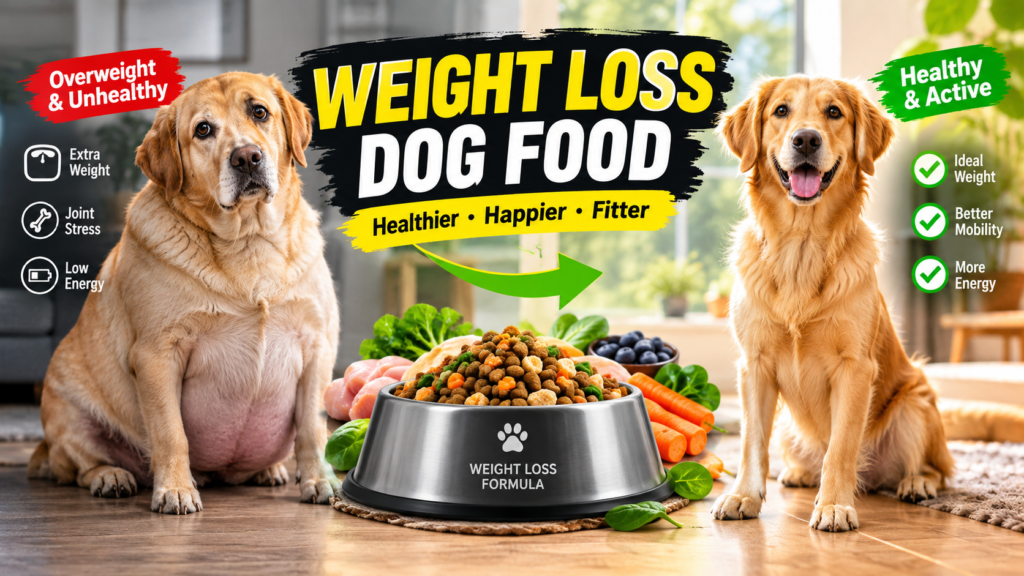
Quick Answer: Dog food for losing weight works by lowering calorie density while keeping protein high and fiber up, so your dog feels full on fewer calories. Look for a formula labeled “weight management” or “light,” feed measured portions (not free-feeding), and pair it with daily activity. Most healthy dogs can lose weight safely at a rate of about 1-2% of body weight per week.
Watching your dog get chunkier is a strange kind of worry. It’s not dramatic. It sneaks up slowly. One day the ribs are easy to feel, and the next you’re struggling to find them at all. I’m Milo Hartwell, and I’ve spent years helping dog owners figure out feeding routines that actually stick, especially when a vet says the word “overweight” for the first time. It’s not as complicated as it sounds, but a few small mistakes can quietly cancel out all your effort. Let’s fix that.
What Is “Weight Loss” Dog Food?
Weight loss dog food, sometimes labeled “weight management” or “light,” is formulated to have fewer calories per cup than regular adult food. The trick isn’t just cutting calories, though. A good formula keeps protein levels high so your dog holds onto muscle while losing fat, and it boosts fiber so your dog still feels satisfied at mealtime instead of hovering by the food bowl all evening.
This is different from simply feeding less of your dog’s current food. Cutting portions of a regular formula can leave gaps in nutrients your dog still needs at a lower calorie intake. A true weight management food is built to deliver full nutrition in a smaller, lighter package.
Why Weight Management Matters for Dogs
Extra weight isn’t just a cosmetic issue. According to the American Veterinary Medical Association, carrying excess weight puts strain on a dog’s joints, heart, and lungs, and it’s linked to a shorter lifespan overall. Overweight dogs also tend to tire faster on walks, which can quietly turn into a cycle of even less activity and more weight gain.
The good news is that even a modest weight loss makes a real difference. Dogs who drop just 6-10% of their body weight often show noticeably more energy and easier movement.
How Weight Loss Dog Food Works
Weight management formulas work through three main levers:
- Lower calorie density — fewer calories per cup, so the same-sized meal has less energy in it.
- Higher fiber — added fiber (often from beet pulp or pea fiber) fills the stomach and slows digestion, so hunger doesn’t spike as fast.
- Higher protein-to-calorie ratio — helps preserve lean muscle mass so the weight lost is mostly fat, not muscle.
Some formulas also add L-carnitine, an amino acid that supports fat metabolism, though this plays a supporting role rather than being the main driver of weight loss.
Step-by-Step: Switching Your Dog to a Weight Loss Diet
- Confirm the need first. Ask your vet to check your dog’s body condition score before starting any diet change. This also rules out medical causes of weight gain, like thyroid issues.
- Calculate the target calories. Your vet or the food packaging can help you figure out daily calorie needs based on your dog’s target weight, not current weight.
- Transition gradually. Mix the new food in over 7-10 days, increasing the new food and decreasing the old, to avoid stomach upset.
- Measure every meal. Use an actual measuring cup or a kitchen scale. Eyeballing portions is one of the biggest reasons diets fail.
- Cut back on treats. Treats should stay under 10% of total daily calories. Swap high-calorie treats for small pieces of plain carrot or green beans.
- Weigh in every 2-4 weeks. Track progress and adjust portions if weight loss stalls or happens too fast.
Signs Your Dog Is Overweight vs. Healthy Weight
| Sign | Healthy Weight | Overweight |
|---|---|---|
| Ribs | Easy to feel with light pressure | Hard to feel under a layer of fat |
| Waist | Visible tuck when viewed from above | No waist, straight or rounded sides |
| Belly profile (side view) | Tucks up behind the ribs | Hangs level or sags |
| Energy on walks | Keeps pace, recovers quickly | Tires early, pants heavily |
| Activity at home | Plays, moves around often | Prefers lying down most of the day |
Common Problems & Fixes
My Dog Seems Hungrier Than Ever
This is one of the most common complaints during a diet switch. It usually means the fiber and protein levels aren’t high enough, or the portion is too small for that dog’s needs. Try splitting meals into two or three smaller feedings instead of one large one, which helps manage hunger cues throughout the day.
My Dog Isn’t Losing Weight
If the scale isn’t moving after 4-6 weeks, the most common culprit is hidden calories: treats, table scraps, or another household member sneaking food. Double-check portion measurements too, since a slightly overfilled cup adds up fast over a month.
My Dog Is Losing Weight Too Quickly
Rapid weight loss can pull from muscle instead of fat and may signal an underlying issue. If your dog drops more than 2% of body weight in a week, check in with your vet.
Common Feeding Mistakes Owners Make
- Free-feeding (leaving food out all day) instead of scheduled, measured meals
- Using a regular cup instead of a proper measuring cup
- Forgetting to count treats and table scraps as part of daily calories
- Switching foods too fast and blaming the new diet for stomach upset
- Not adjusting portions as the dog loses weight
Pro Tips for Faster, Safer Results
- Use a kitchen scale instead of a cup for the most accurate portions
- Add a short walk before mealtime; dogs often settle faster afterward
- Puzzle feeders slow down fast eaters and make meals feel bigger
- Keep a simple weight log on your fridge or phone to catch stalls early
- Recheck body condition monthly rather than relying on the scale number alone
Do’s and Don’ts of Weight Loss Feeding
| Do | Don’t |
|---|---|
| Measure every meal precisely | Eyeball portions “by feel” |
| Transition foods gradually over 7-10 days | Switch foods overnight |
| Count treats toward daily calories | Treat treats as “free” food |
| Recheck weight every 2-4 weeks | Wait months between check-ins |
| Involve your vet for a starting plan | Guess at target calories |
Dry vs. Wet Diet Food: What’s the Difference?
Dry weight management food is generally more calorie-dense per gram, so portions look smaller, which can be discouraging for dogs used to bigger meals. Wet diet food has higher water content, so portions look larger and more satisfying for the same calorie count, but it can be pricier and spoils faster once opened. Some owners mix a small amount of wet food into dry to add volume without adding many calories.
FAQ
How much weight should my dog lose per week?
A safe target is around 1-2% of body weight per week. For a 40-pound dog, that’s roughly 0.4-0.8 pounds weekly.
Do I need a prescription diet, or is over-the-counter weight loss food enough?
Most healthy dogs do well on an over-the-counter weight management formula. Prescription diets are usually reserved for dogs with significant obesity or a related medical condition, and your vet can advise which fits your dog.
Can I just feed less of my dog’s current food instead of switching?
You can, but it risks nutrient shortfalls at lower calorie intakes. A dedicated weight management formula is built to stay nutritionally complete even at reduced calories.
Will grain-free food help my dog lose weight?
Not on its own. Grain-free isn’t the same as low-calorie, and some grain-free formulas are actually higher in fat and calories. Focus on the calorie content and fiber level instead.
How long does it typically take to see results?
Most owners notice a difference in energy within 2-3 weeks, with visible body changes taking around 8-12 weeks depending on how much weight needs to come off.
Should I stop giving treats completely?
No, just adjust them. Keep treats under 10% of daily calories and choose lower-calorie options like small vegetable pieces.
What if my dog is overweight but seems perfectly happy and active?
Extra weight can hide reduced stamina that owners don’t notice day to day. It’s still worth addressing early, since joint and organ strain builds up gradually. A quick check with your vet, referenced from the ASPCA, can confirm whether a diet plan makes sense.
Conclusion
Getting a dog to a healthier weight isn’t about dramatic changes. It comes down to picking a real weight management food, measuring meals honestly, and tracking progress every few weeks instead of guessing. Small, consistent adjustments beat any quick fix. If you’re ever unsure whether your dog’s weight loss is on track, a quick check-in with your vet is always worth it. For more general pet nutrition guidance, the PetMD nutrition section is a solid resource to bookmark.
