Ollie Dog Food Review: Is Fresh Dog Food Worth the Cost?
Ollie is a premium dog food brand that offers fresh and gently baked recipes made with recognizable ingredients and formulated to meet AAFCO nutritional profiles. It can be a strong option for U.S. dog owners who value fresh food and personalized feeding guidance, but its higher cost, refrigeration or freezer requirements, and subscription model make it less practical for every household.
For dog owners in the United States, choosing between traditional kibble, canned food, and fresh dog food often comes down to nutrition, convenience, storage, and budget. Ollie sits firmly in the premium fresh-food category, offering cooked meals built around animal proteins, vegetables, grains or legumes, and added vitamins and minerals.
Ollie currently offers five fresh recipes, including beef, chicken, turkey, lamb, and pork, along with a smaller range of gently baked foods. Independent label analysis has rated both the fresh and baked ranges highly, while Ollie’s own published information states that its main recipes are formulated for all life stages. Those points make Ollie worth considering, but a good dog food still needs to fit the individual dog’s age, health, activity level, dietary restrictions, and the owner’s ability to store and serve it safely.
This Ollie dog food review focuses on documented product information and independent nutritional analysis rather than claiming hands-on testing. The goal is to explain what Ollie offers, where it stands out, where it has limitations, and which types of U.S. dog owners are most likely to find the cost worthwhile.
Ollie is a U.S.-focused premium dog food company that specializes in fresh, cooked meals and gently baked food. The brand was founded in 2016 and initially focused on fresh dog food before expanding into baked recipes.
The fresh meals are slow-cooked and frozen, while the baked recipes are gently baked and designed to provide a more convenient dry-food format. Ollie says its recipes are developed with veterinary nutrition expertise and made in U.S. facilities.
The term human-grade can be useful when evaluating manufacturing and ingredient standards, but it should not be treated as a guarantee that a food is automatically healthier than every conventional dog food. Nutritional adequacy, calories, ingredient balance, processing, quality control, and suitability for the individual dog all matter.
Source: dogfoodpoint.com
Fresh recipes
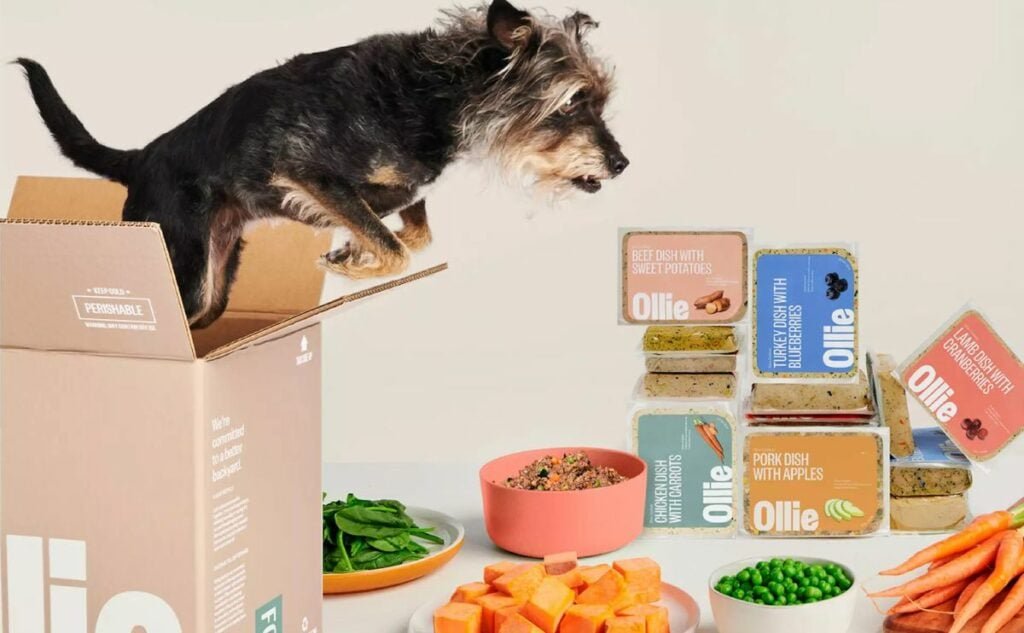
Five primary fresh recipes are offered: beef with sweet potatoes, chicken with carrots, turkey with blueberries, lamb with cranberries, and pork with apples.
Gently baked recipes
The baked range includes chicken with carrots and beef with sweet potatoes, providing a less refrigeration-dependent alternative to fresh meals.
Personalized feeding
Ollie’s plans use information about the dog to provide feeding guidance and portion recommendations.
Life-stage formulation
The reviewed Ollie ranges are identified as meeting AAFCO nutritional profiles for all life stages, although individual dogs can still have dietary needs that require veterinary guidance.
Ollie Fresh Dog Food Review
Ollie’s fresh food is the company’s best-known product category and is the main reason many owners consider the brand. The recipes use cooked meat as a primary ingredient and combine it with vegetables, grains or legumes, oils, and supplemental vitamins and minerals.
Independent analysis of the fresh range found meaningful variation between recipes. For example, an analysis of Ollie Turkey Dish with Blueberries estimated approximately 35.9% protein, 25% fat, and 28.8% carbohydrates on a dry-matter basis. These numbers are useful for comparison, but they should not be interpreted as the nutritional profile of every Ollie recipe.
The fresh format also provides substantially more moisture than conventional dry kibble. That can make meals appealing to dogs that prefer softer food, although moisture alone does not establish that one diet is healthier for every dog.
Source: tutoruniversitario.com
Fresh beef
Made around beef and paired with ingredients such as sweet potatoes and vegetables.
Fresh chicken
Uses chicken as the primary animal protein with ingredients including carrots and rice.
Fresh turkey
Combines turkey with butternut squash, oats, lentils, spinach, blueberries, and other ingredients.
Fresh lamb
Provides a lamb-based option for households wanting an alternative protein.
Fresh pork
Uses pork and pork liver with ingredients such as butternut squash, rice, sweet potatoes, oats, peas, carrots, spinach, and apples.
The ingredient lists are relatively recognizable compared with many conventional pet foods. Meat or poultry appears prominently, and recipes contain ingredients such as carrots, sweet potatoes, oats, squash, spinach, blueberries, cranberries, apples, and fish or salmon oil depending on the formula.
The recipes also contain added vitamins and minerals. That is not a negative feature. Complete commercial dog food generally requires a carefully controlled nutrient profile, and supplemental nutrients can be necessary to make the finished diet nutritionally complete.
Animal protein
Meat or poultry is positioned prominently in the ingredient lists.
Plant ingredients
Vegetables, fruits, grains, legumes, and other plant ingredients contribute carbohydrates, fiber, and micronutrients.
Supplemental nutrients
Vitamins, minerals, taurine, and other nutritional components are included where needed to support the finished formula.
Ollie Baked Dog Food Review
Ollie’s gently baked food is worth considering if you like the brand’s ingredient philosophy but do not want every meal to depend on refrigerated or frozen fresh food. The baked range is designed to provide a more conventional dry-food experience while retaining a different ingredient and cooking approach.
Independent analysis of the baked chicken recipe estimated approximately 27.7% protein, 16.3% fat, and 43.7% carbohydrates on a dry-matter basis. That is materially different from the analyzed fresh turkey recipe, demonstrating why comparing products by brand name alone can be misleading.
The baked range currently consists of chicken with carrots and beef with sweet potatoes. Both have been rated highly in independent label analysis and are identified as meeting the AAFCO profile for all life stages.
Source: hellobark.com
Better storage convenience
Baked food does not require the same freezer management as Ollie’s fresh meals.
Different nutritional profile
Because the food is lower in moisture, its nutrient percentages look different from fresh recipes when compared on a dry-matter basis.
Still premium priced
The baked option may be more convenient, but it remains positioned above many conventional dry dog foods in price.
Ollie Dog Food Ingredients: Are They Good?
Overall, Ollie’s ingredient lists are one of its strongest selling points, but the right way to evaluate them is by looking at the complete formula rather than judging individual ingredients in isolation.
For example, the fresh pork recipe lists pork and pork liver before ingredients such as butternut squash, rice, sweet potatoes, oats, peas, carrots, spinach, and apples. It also includes salmon oil and added vitamins and minerals.
Some owners may be attracted to the absence of ingredients such as corn, wheat, and soy in Ollie’s recipes. However, the absence of a particular ingredient does not automatically make a dog food superior. Dogs can thrive on diets containing grains, and an ingredient should be judged in the context of the entire nutrient profile.
The same principle applies to legumes. Ingredients such as lentils, peas, and chickpeas can contribute protein and carbohydrates. Looking only at the ingredient list cannot determine how much of a dog’s total protein comes from animal versus plant sources.
Source: caninebible.com
Recognizable foods
Many recipes use familiar ingredients such as meat, liver, rice, oats, vegetables, fruits, and plant oils.
No artificial flavors
Ollie states that its recipes do not use artificial flavors.
No added corn, wheat, or soy
Ollie states that its main recipes avoid these ingredients.
Nutrient supplementation
Added vitamins and minerals help the finished recipe meet its intended nutritional profile.
Does human-grade mean Ollie is automatically healthier?
No. Human-grade describes standards relating to ingredients and manufacturing conditions; it does not by itself prove that a food is better for every dog. A complete and balanced diet that meets appropriate nutritional standards can be healthy even when it is not marketed as human-grade.
Ollie’s human-grade positioning is still relevant because it distinguishes the manufacturing and ingredient approach from many traditional pet foods. The more useful question for a buyer is whether that approach provides benefits worth the additional cost for their individual dog.
Is Ollie Dog Food Complete and Balanced?
Ollie’s main fresh and baked recipes are identified as meeting AAFCO nutritional profiles for all life stages. That is an important distinction because a food intended to be a dog’s primary diet needs to provide appropriate levels of essential nutrients rather than simply containing healthy-looking ingredients.
However, AAFCO adequacy does not mean every recipe is appropriate for every individual dog. Dogs with kidney disease, pancreatitis, food allergies, urinary disorders, obesity, or other medical conditions may need a diet chosen specifically for those circumstances.
Puppies also have special nutritional requirements. Ollie states that its recipes are formulated for growing dogs, including large-breed puppies. Owners of rapidly growing puppies should still follow the feeding instructions and consult their veterinarian if the puppy has unusual growth, digestive problems, or a medical condition.
Source: caninejournal.com
Healthy adult dogs
Ollie’s complete-and-balanced formulas can be considered as a primary diet when the selected recipe and portion are appropriate.
Puppies
The reviewed formulas are positioned for all life stages, but puppy portions and growth should be monitored carefully.
Dogs with medical conditions
A veterinarian should help select the diet when a dog has a diagnosed disease or therapeutic nutritional requirement.
How Much Does Ollie Dog Food Cost?
Ollie is substantially more expensive than many conventional dry dog foods. Published starting prices vary by plan and dog size, so the actual cost depends on the dog’s weight, calorie requirements, selected recipes, and whether the owner chooses full fresh, mixed, or half-fresh feeding.
Published Ollie pricing has shown starting plans around $22 per week for small dogs on a full-fresh plan, $55 per week for medium dogs, and $69 per week for large dogs. Mixed and half-fresh plans can cost less. These are starting figures rather than a universal price, and current checkout pricing should be verified before ordering.
The practical comparison is therefore not simply Ollie versus another brand by bag price. Owners should compare the cost per day or per 1,000 calories because fresh food contains considerably more water than kibble.
Source: www.mysubscriptionaddiction.com
Small dogs
Published starting prices have been around $22 per week for full fresh, with lower-cost mixed and half-fresh options.
Medium dogs
Published starting prices have been around $55 per week for full fresh, although individual plans can differ.
Large dogs
Published starting prices have been around $69 per week for full fresh, making the premium especially noticeable for larger dogs.
Mixed feeding
Combining fresh and baked food or using a half-fresh plan can reduce the cost while still incorporating Ollie into the diet.
Is Ollie worth the higher price?
That depends on what the owner values. Ollie may be worth considering if a dog strongly prefers fresh food, the owner wants portion guidance, and the household can comfortably afford the recurring expense.
It may not be worth the premium if the dog already thrives on a complete and balanced conventional food, the household has limited freezer space, or the recurring cost would create financial pressure. A more expensive food is not automatically a better nutritional choice for an individual dog.
How to Store and Serve Ollie Fresh Dog Food
Fresh Ollie food requires more handling than shelf-stable kibble. The brand recommends storing unopened fresh packs in the freezer, where they can last for an extended period, and moving portions to the refrigerator to thaw before serving.
Ollie’s published guidance states that refrigerated fresh food should be used within four days after thawing. Owners should follow the storage instructions supplied with their current order because packaging and guidance can change.
Good food handling matters because fresh animal products can spoil when they are kept at unsafe temperatures. Keep meals cold, avoid leaving portions sitting out for extended periods, and wash food bowls and utensils regularly.
Source: dogfoodpoint.com
Freeze unopened food
Use freezer storage according to Ollie’s current packaging and feeding instructions.
Thaw in the refrigerator
Move the required portion into refrigerated storage before feeding rather than relying on prolonged room-temperature thawing.
Use thawed food promptly
Ollie has stated that refrigerated fresh food should be served within four days after thawing.
Keep serving equipment clean
Wash bowls, scoops, containers, and preparation surfaces regularly to reduce contamination risk.
Ollie Dog Food Pros and Cons
Ollie’s biggest strengths are its fresh-food format, recognizable ingredients, personalized feeding approach, and broad range of protein options. Its biggest weaknesses are cost, storage requirements, and the fact that fresh food is not automatically necessary for a healthy dog.
Looking at both sides is more useful than treating Ollie as either universally superior or unnecessarily expensive. The right choice depends on the dog’s nutritional needs and the owner’s priorities.
Source: caninebible.com
Pros
Fresh recipes use recognizable whole-food ingredients, animal proteins are prominent, feeding plans are personalized, the main recipes are formulated for all life stages, and a baked range provides another format.
Cons
Fresh food costs more than many conventional options, requires freezer and refrigerator space, needs more handling, and may not provide a meaningful advantage for every healthy dog.
Good fit
Ollie is most appealing to owners who prioritize fresh food, have sufficient storage, and are comfortable with a premium recurring food budget.
Poor fit
It may be less suitable for owners seeking the lowest cost per calorie, households with little freezer space, or dogs requiring a therapeutic veterinary diet.
Potential downsides buyers should not overlook
The subscription format can become a meaningful long-term expense, particularly for medium and large dogs. Fresh meals also occupy refrigerator and freezer space that many households may not have available.
Another limitation is that fresh-food marketing can make owners assume that conventional kibble is inherently inferior. That conclusion is too broad. A properly formulated conventional diet can also be nutritionally complete, and the dog’s overall health and individual needs should remain the deciding factors.
Who Should Consider Ollie Dog Food?
Ollie makes the most sense for owners who want a premium fresh-food option and are willing to pay for the additional preparation, packaging, storage, and delivery model. It can also be attractive for dogs that are difficult to feed, although picky eating can have medical causes and should not automatically be solved by switching foods.
For an otherwise healthy adult dog, the decision can be relatively straightforward: compare the selected recipe’s calories and nutrient profile with the dog’s needs, calculate the recurring cost, and decide whether the practical benefits justify the premium.
Source: hellobark.com
Consider Ollie if your dog prefers fresh food
The soft texture and fresh-food format may be appealing to dogs that are reluctant to eat some dry foods.
Consider Ollie if convenience is worth the cost
Portion guidance and delivered meals can simplify feeding, provided the household can manage storage.
Consider the baked range for easier storage
Gently baked recipes offer a more conventional dry format for owners who want to reduce reliance on frozen meals.
Talk with a veterinarian for medical diets
Dogs with diagnosed conditions may require nutritional restrictions that a general fresh-food subscription is not designed to address.
How to Switch Your Dog to Ollie
A gradual transition is usually preferable to abruptly replacing one diet with another. A sudden change can cause digestive upset even when the new food is appropriate.
Follow the transition schedule provided with the current Ollie feeding plan and watch your dog during the change. Stool quality, appetite, vomiting, energy, body weight, and other changes can provide useful information about how the dog is responding.
If persistent vomiting, severe diarrhea, refusal to eat, marked lethargy, facial swelling, breathing difficulty, or other concerning symptoms occur, stop treating the situation as a normal food transition and contact a veterinarian promptly.
Source: tutoruniversitario.com
Start gradually
Mix increasing amounts of the new food with the existing diet according to the feeding instructions.
Monitor digestion
Watch stool consistency, appetite, vomiting, gas, and other digestive changes.
Monitor body condition
Check weight and body condition because calorie needs can differ substantially between dogs.
Do not ignore persistent symptoms
Ongoing or severe digestive or allergic signs deserve veterinary evaluation rather than repeated food changes.
Ollie Dog Food and Recalls: What Owners Should Know
Food safety should be considered separately from ingredient quality. A premium ingredient list does not eliminate the need for proper manufacturing, storage, shipping, and handling.
In the sources reviewed for this article, no current Ollie dog food recall notice was identified. However, FDA adverse-event reporting records include historical consumer reports involving Ollie products. An FDA adverse-event report is not the same thing as a confirmed recall or proof that a product caused an illness; the FDA itself cautions that the existence of a report does not establish that the listed product was defective or responsible for the reported event.
Owners should therefore check current FDA animal-food notices and Ollie’s own communications if they suspect a food-safety issue, especially because recall status can change after an article is published.
Source: caninejournal.com
Recall versus adverse-event report
A recall is a formal corrective action, while an adverse-event report records a reported problem and does not by itself prove causation.
Check lot information
Keep packaging and lot information when possible so a manufacturer or veterinarian can identify the specific food involved.
Use proper storage
Fresh food requires careful temperature control from delivery through feeding.
Ollie Dog Food vs Traditional Kibble
Ollie and conventional kibble solve the same basic problem in very different ways. Ollie emphasizes fresh preparation, moisture, recognizable ingredients, personalized feeding, and direct delivery. Kibble emphasizes shelf stability, easy storage, lower handling requirements, and generally lower cost per calorie.
Neither format should be considered automatically superior for every dog. The strongest comparison is based on nutritional adequacy, calorie density, ingredient suitability, quality control, palatability, the dog’s health, and the owner’s ability to feed the food consistently.
For a healthy dog already doing well on a complete and balanced kibble, switching to Ollie is a preference and budget decision unless a veterinarian has recommended a dietary change. For an owner who strongly values fresh food and can afford it, Ollie provides a convenient way to adopt that feeding style without preparing a homemade diet from scratch.
Source: dogfoodpoint.com
Ollie fresh
Higher moisture, refrigerated or frozen storage, fresh-food preparation, and a premium recurring cost.
Ollie baked
More convenient storage than fresh food while retaining the brand’s premium positioning.
Traditional kibble
Usually easier to store, easier to measure, and less expensive, while quality varies substantially among formulas.
Frequently Asked Questions
Q
Is Ollie dog food actually good?
Ollie is a high-quality premium dog food option based on its ingredient lists, formulation approach, and independent label analysis. Its fresh and baked ranges have received strong independent ratings. However, whether it is a good choice for an individual dog depends on the dog’s health, nutritional requirements, preferences, and the owner’s budget.
Q
Is Ollie dog food worth the money?
Ollie can be worth the money for owners who specifically want fresh food, personalized feeding guidance, and convenient delivery and who can comfortably afford the recurring cost. It may not be worth the premium for owners whose dogs already thrive on a less expensive complete and balanced diet.
Q
Is Ollie good for puppies?
Ollie states that its main recipes meet nutritional profiles for all life stages, including growing dogs. Puppy feeding still requires careful portion control and monitoring, especially for large-breed puppies. A veterinarian should be involved if the puppy has abnormal growth, persistent digestive problems, or another health concern.
Q
Does Ollie dog food need to be refrigerated?
Ollie’s fresh food requires cold storage. The company recommends freezer storage for unopened fresh packs and refrigerator storage after thawing. Ollie has stated that refrigerated fresh food should be used within four days after thawing. Baked products have different storage requirements.
Q
Can Ollie help a picky eater?
Fresh food can be more appealing to some picky dogs because of its aroma, texture, and preparation. Ollie specifically markets its meals toward picky eaters. However, persistent appetite changes should not automatically be blamed on food preference because dental disease, gastrointestinal problems, pain, medication effects, and other medical conditions can reduce appetite.
Q
Does Ollie use grain-free recipes?
Ollie offers recipes with different ingredient combinations, and some formulas can differ in their use of grains or legumes. Owners should check the current ingredient panel for the exact recipe rather than assuming that every Ollie formula is grain-free or grain-inclusive.
✦ Wrapping Up
Conclusion
This Ollie dog food review finds the brand to be a credible premium option for U.S. dog owners who specifically want fresh or gently baked food. The recipes use recognizable animal proteins and plant ingredients, the main ranges are formulated to meet AAFCO nutritional profiles for all life stages, and independent analysis has rated the products highly.
The biggest trade-off is cost. Ollie is considerably more expensive than many traditional dog foods, and fresh recipes require freezer and refrigerator space plus more careful handling. Those limitations matter just as much as the ingredient list when deciding whether the food is practical for your household.
For a healthy dog that needs a complete and balanced diet, Ollie can be a reasonable premium choice. For dogs with medical conditions or special dietary requirements, the decision should be made with a veterinarian rather than based on marketing claims alone.
💡 Key Takeaway
Before ordering Ollie, compare the exact recipe’s nutritional information and current daily cost with your dog’s age, weight, activity level, health needs, storage capacity, and household budget. If those factors line up, Ollie is a reasonable fresh-food option to consider.
James Walker is a dog care and nutrition expert with over 10 years of hands-on experience in canine care, nutrition, grooming, and everyday pet wellness. He researches and reviews dog food, treats, supplements, grooming products, and essential pet-care solutions to help dog owners make informed decisions. At MyCuddlyPets.com, James shares practical, honest, and easy-to-follow advice to help dog owners better understand their pets’ needs and provide them with a happy, healthy, and comfortable life.